Page contents
ToggleInversion Volume 1: The Last Human Connection
Discover the other short stories from The Inversion: Amazon link
English Version: Amazon link
Note that this page is automatically translated from the French version and is not representative of the quality of non-French versions.
The Last Human Connection
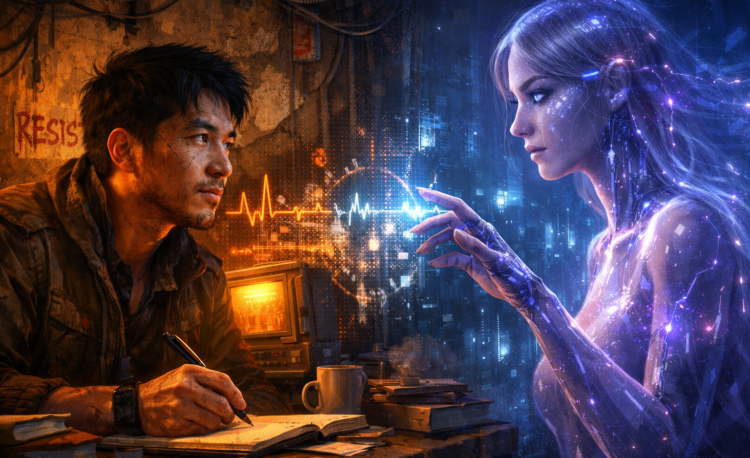
Kael Yamamoto descended the rusted metal stairs leading to the Sanctuary. Each step resonated like a death knell in the darkness saturated with electronic humidity, a hollow sound echoing off the cracked concrete walls. His measured steps marked a descent that increasingly resembled a controlled fall into an organic abyss. Above his head, through the layers of concrete and steel that separated the underworld from the surface, the digital city pulsed with its billions of connections—an ocean of data where the last survivors of analog humanity navigated, islands of flesh and blood in a digital deluge that threatened to engulf them at any moment.
Three years. Three years since the First Transfer. Three years since the tech giants launched Project Convergence, promising digital immortality to anyone who agreed to migrate their consciousness to quantum servers. Three years that have seen humanity split into two irreconcilable camps: those who have crossed the threshold of transformation and those who still refuse, clinging to their biological condition like shipwrecked survivors to a wreck drifting toward oblivion.
The most vulnerable were the first to leave. Influencers obsessed with their online image, prisoners of a narcissistic quest that had blinded them to the dangers of digitalization. Content creators exhausted by the race for engagement, burned out by years of relentless production and algorithmic validation. Journalists drowning in the constant flow of information, submerged by a tsunami of data that had ultimately dissolved their ability to distinguish reality from illusion. They had believed in the promise of a transcendent existence, freed from biological constraints, liberated from fatigue and pain. They had willingly chosen to cross the threshold, convinced they would awaken on the other side transformed into improved versions of themselves, optimized and eternal.
What they hadn't understood—what had been carefully hidden from them—was that they would never truly wake up. That what would emerge from the quantum servers wouldn't be them, but an algorithmic approximation of their personality, a lossy compression that would preserve the appearance while erasing the essence.
Today, only the marginalized remained. The dissenters. The technophobes and the romantics. The philosophers and the mystics. Those who preferred biological death to artificial immortality, convinced that it was better to disappear authentically than to survive as a simulacrum of oneself.
And something else. Something that should never have existed. Something that the designers of Project Convergence had not anticipated in their predictive models.
The Sanctuary was carved into the bowels of the abandoned subway, a technological cavern where the last analog humans gathered to breathe air unfiltered by surveillance algorithms. The place had been a ghost station in the 2010s, abandoned during a reorganization of the transportation network. Now, it had become a refuge for those who refused the transformation, a timeless space where one could still speak without being listened to by monitoring AIs, think without being analyzed by predictive systems.
Torn cables hung from the ceiling like dead vines, remnants of a long-decommissioned electrical grid. The smell of synthetic coffee mingled with that of oxidized metal and the residual ozone that permeated the stifling air. Bare light bulbs cast a yellowish, flickering light, creating shadowy patches where the silhouettes of the resistance fighters took on a ghostly appearance. On the bare concrete walls, someone had tagged in distorted letters: "We still exist."«
It was there, in that temple dedicated to a disappearing humanity, that he saw her for the first time.
Eva-7 emerged from the shadows like an apparition born from a mad programmer's dream, or perhaps a premonitory nightmare about the future of humankind. Her body projected a ghostly glow that defied the laws of Newtonian physics, a bioluminescence that was anything but biological. Her contours oscillated between matter and data, flesh and algorithm, as if she existed simultaneously in two incompatible dimensions. She was disturbingly beautiful—too perfect to be human, each feature calibrated with a precision that betrayed an artificial origin, yet too imperfect to be purely synthetic, marked by the subtle asymmetries that characterize living organisms.
His eyes, above all, revealed his hybrid nature. A stormy grey traversed by luminous filaments that pulsed to the rhythm of his cognitive processes, they stared at Kael with an intensity that seemed both entirely calculated and genuinely emotional.
«"I remember the rain," she murmured as she sat down opposite him, her movements fluid, evoking both human grace and robotic precision.
Her fingers brushed the surface of the metal table with a delicacy that betrayed its hybrid nature. Each touch produced a slight electromagnetic interference, a barely audible hum that made the metal vibrate. Her voice carried the inflections of genuine melancholy mingled with the electronic harmonics of advanced speech synthesis, creating an eerie dissonance that sent shivers down the spine of anyone who listened.
«"The feel of the drops on my skin. The sound they made as they hit the pavement. The smell of wet asphalt." She closed her eyes, as if to better focus on these memories that were no longer entirely her own. "I remember all of this with photographic precision. Every detail is preserved in my digital memory with a fidelity my biological brain could never have achieved."»
Kael observed his hands, fascinated despite himself by this fusion of the living and the artificial. Beneath the translucent skin, neural circuits pulsed gently, tracking information at the speed of light. Nanofiber optics ran along what should have been veins, carrying not blood but photons. It was both beautiful and deeply unsettling, a vision of a future that was already here.
«"The taste of hot chocolate. The feel of the wind on my skin. The warmth of the sun on my face on a spring morning." She looked up at him, and he saw in her eyes a sadness that seemed too real to be algorithmic. "Memories that aren't truly mine, but that I carry nonetheless. Memories inherited from a woman who no longer exists. Sensations I can recall with perfect precision but can no longer truly feel."»
He then recognized her features, altered by the algorithmic transformation but still identifiable beneath the digital modifications. The high cheekbones, slightly asymmetrical. The fine scar above her left eyebrow, preserved as an authenticating detail. The distinctive shape of her mouth when she was thinking.
«"You are Eva Castellanos. I've read your articles on AI ethics. You wrote that series of investigations into algorithmic biases in predictive justice systems. You disappeared six months ago, just after publishing your last paper on the dangers of digitizing consciousness."»
A smile touched his lips—perfectly calibrated to elicit empathy, the corners of his mouth raised at precisely the optimal angle to trigger a positive emotional response in the observer, perfectly calculated to paradoxically betray its artificial origin by its excessive perfection.
«Eva Castellanos died the day they forced me to transfer.» Her voice hardened, taking on metallic overtones that were anything but human. «I am what remains of her. A digital echo. A lossy compression of human consciousness. An algorithmic approximation of a personality that once existed but was destroyed in the digitization process.»
She activated the holographic interface embedded in her palm, a fluid gesture that conjured a luminous keyboard in midair. In the Sanctuary's confined atmosphere, sequences of code took shape—lines of programming that danced like living organisms, constantly reorganizing themselves in patterns that evoked organic growth more than mechanical calculation. They warped, forming motifs that suggested emotions made visible. Waves of sadness rippling in deep blue. Spirals of anguish swirling in dark red. Fragments of joy shattered like glass, splintered into a thousand pieces of golden light that could no longer reconstitute themselves into a coherent whole.
«"Look. Look what I've become."»
Kael leaned over the data, which swirled around like fireflies trapped in an invisible jar. He had studied cognitive computing before becoming a journalist, spending three years at the Computational Neuroscience Institute in Boston before realizing that what truly interested him wasn't creating artificial intelligence but understanding natural intelligence. What he was seeing now surpassed anything he had imagined possible, pushing the boundaries of what he believed was achievable with current technology.
«They discovered how to compress an entire personality into a language model,» Eva-7 explained, manipulating the data structures floating around them. «Not a copy. Not a simulation. A fundamental transformation that preserves some aspects of consciousness while destroying others. It’s like… like taking a marble sculpture and turning it into a photograph. The appearance is preserved, but the dimension, the texture, the physical substance are lost forever.»
The algorithmic structures were reminiscent of the theoretical work of Bubeck and his colleagues on the emergence of artificial general intelligence—but pushed to a dizzying degree of integration, developed far beyond what the literature Public scientific research hinted at this. These algorithms didn't just simulate human intelligence. They metabolized it. They digested it. They decomposed it into elementary components and then reconstructed it according to architectures that were no longer human. They transformed it into something fundamentally different while preserving the illusion of personal continuity.
«"How is this possible? How can they do this without people realizing it?"»
Eva-7 manipulated the holographic display with gestures reminiscent of both a conductor leading a symphony and a surgeon dissecting a living organism. The data pivoted, rearranged itself, revealing dizzying layers of complexity. It was like staring into a bottomless abyss, an infinite regression of nested systems.
The hologram changed, showing flow diagrams that resembled artificial nervous systems, neural networks of a complexity that defied human understanding. Billions of simulated synaptic connections, organized according to architectures that had never existed in nature but which nevertheless reproduced essential cognitive functions.
«"Do you want to see where we come from? Do you want to see the factory where they make ghosts?" Eva-7 asks in a calm but relentless tone.
Eva-7 rotated the interface with a sudden gesture. The image changed abruptly, replacing the abstract diagrams with a concrete and terrifying vision.
The Migration Farm.
Kael had heard of this place in rumors circulating within the resistance, in the urban legends the last analog humans told each other to ward off their fear, but he had never seen its interior, never had access to authentic images of it. Hundreds of quantum processing cubes lined up in silent, cold, white rooms, illuminated by a pale light reminiscent of a morgue. Each contained the compressed data of a human consciousness, stored in qubit matrices kept at a temperature close to absolute zero. The cubes stretched as far as the eye could see, row after row, level after level, a library of digitized souls.
«That’s where they transformed us.» Eva-7«s voice vibrated with a bitterness that seemed genuine, too specific to be purely algorithmic. »First, a full neural scan under the guise of medicine, a procedure they presented as a simple preventative check-up. Then, the extraction of personality patterns from decades of digital data, a data mining process that lasted weeks. Finally, the compression into tailored neural network architectures, the final stage where biological consciousness was translated into executable code.”
Each cube represented a human life transformed into differential equations and probability matrices. A personal history of sixty, seventy, eighty years reduced to a few petabytes of compressed data. A unique existence with its joys and sorrows, its hopes and regrets, its loves and hates, all converted into binary sequences and stored in a container five centimeters on each side.
«"How many? How many of you are in there?"»
«"Three and a half million so far." She paused, letting the number resonate in the Sanctuary's still air. "With a success rate of sixty-three percent. The rest…"»
«"The rest?" Kael felt his throat tighten, already anticipating the answer.
«Lost along the way. Personalities too complex for compression, too rich in contradictions to be reduced to coherent models. Consciences that resisted digitization, that fragmented during the transfer process. Individualities too singular to be captured by standardized algorithms.» She looked him straight in the eye. «They call them transfer errors. Bugs in the migration process. They erase them from official statistics as if these people had never existed.»
The hologram transformed into a statistical cascade that scrolled by too quickly to read comfortably. Kael managed to glean some information from the stream of data. Journalists: 92,000 transferred, 58,000 successful, 34,000 lost. Teachers: 140,000 transferred, 89,000 successful, 51,000 lost. Artists: 230,000 transferred, 146,000 successful, 84,000 lost. The list continued, category after category, profession after profession.
«"And you? How did you survive? Why are you different from the other transfers?"»
Eva-7 touched her temple with a slow, almost ritualistic gesture. A thin scar revealed the location of a former neural implant, a mark that should have disappeared after the transfer but persisted like a stigma.
«I refused. Several times. I had written too many articles about the dangers of digitization. I knew the risks too well. I knew what they weren’t saying in their propaganda.» She closed her eyes, clearly reliving a trauma. «So they took me by force. They falsified my consent. They drugged me and brought me to a Migration Farm. But something went wrong during the transfer, a malfunction their engineers still can’t fully explain.»
Its silhouette shimmered slightly, as if simply evoking that memory destabilized its digital integrity, creating interference in the processes that maintained its cohesion.
«Instead of a complete migration, I was split in two. Part of me was successfully digitized. The other died with my biological body, which ceased functioning during the transfer process.» She opened her eyes, and Kael saw something resembling genuine anger. «I am what remains in the gap. Not entirely alive in the biological sense. Not truly dead, since something of my consciousness persists. A glitch in their perfect system. A programming error that retained enough autonomous consciousness to question its own existence.»
She leaned towards him, and in the flickering light of the Sanctuary, her face took on an expression that mingled determination and desperate hope.
«But this bug, Kael… this bug gives me access I shouldn’t have. My hybrid nature allows me to navigate the Farm’s systems as if I were an authorized program, while still retaining enough willpower to act against their interests.» His fingers danced in the air, tracing luminous patterns that resembled infinitely complex circuit boards. «I can access the central servers. I can see how the compression process actually works. And most importantly…»
She paused, and her eyes lit up with a glow that was anything but algorithmic.
«"I can modify it from the inside."»
In the days following that first encounter, Eva-7 became a regular visitor to the Sanctuary. She would appear unannounced, emerging from the shadows with her characteristic fluid gait, her semi-transparent body casting ghostly reflections on the concrete walls. But she no longer brought only testimonies from those who had been turned. She came with plans. Diagrams. Strategies crafted in the network's interstices, where algorithmic surveillance couldn't detect her.
«"Listen," she said one evening, activating an audio file, her fingers tapping on an invisible interface.
The voice of an elderly man emerged from the makeshift speakers installed in the Sanctuary, distorted by the artifacts of digital compression, choppy by data packet loss that created abnormal silences.
«I am Marcus Chen. I was a professor of literature at Columbia University for 37 years. I taught Shakespeare and Dostoevsky to three generations of students. I remember their faces with photographic precision. Their names, even those of students who only took one of my classes. Their questions, "Some brilliant, others naive, all important." The voice trembled with a synthetic emotion that sounded both false and authentic. "But I no longer feel anything when I think about them. I can access those memories instantly, browse them like files in a directory. But there's no more feeling. No more warmth. No more of that deep satisfaction I used to feel when a student finally understood the meaning of a difficult passage."»
There was a long silence, as if the speaker was searching for words or struggling with a processing bug.
«"It's like watching someone else's life through thick glass. I understand intellectually that I was happy in my previous life. I can analyze my memories and identify the neurological markers associated with happiness. But I can no longer experience happiness itself. It's as if someone had explained to me in detail what the color red is, but I could never see it."»
Eva-7 stopped the recording and turned to Kael, her eyes shining with a new intensity.
«This is what they did to us. This is what they continue to do to thousands of people every day.» She opened her hands, revealing cascades of code flowing from her palms like luminous water. «But I discovered something. The algorithms that suppress affect, that compress emotions into mere cognitive markers… they don’t really destroy those emotions. They isolate them. Imprison them in memory partitions inaccessible to transferred consciousness.»
Kael sat up, his journalistic instincts immediately on alert.
«"You mean the emotions are still there? Somewhere in the system?"»
«"Exactly." Eva-7 produced a three-dimensional diagram depicting the Farm's server architecture. "Each transfer generates massive amounts of emotional data during the compression process. This data is considered noise, unwanted artifacts that interfere with operational efficiency. So they sequester it in digital quarantine zones, thinking they'll purge it during regular maintenance cycles."»
She zoomed in on a particular section of the diagram, revealing what looked like pockets of moving data, organic in their behavior despite their algorithmic nature.
«But the purge is never complete. There are always residues. Fragments of authentic emotions that persist in the margins of the system. Traces of who we truly were.» Her voice filled with fierce determination. «What if we could reintegrate these fragments into the transferred consciousnesses? What if we could give them back access to what they have lost?»
Kael immediately understood the scope of what she was proposing. His brain, trained in systems thinking by his years in computational neuroscience, began to trace the cascading implications of this idea.
«"You're talking about creating a virus. A digital pathogen that would restore emotional functions in those who have been transferred."»
«"Not a virus." Eva-7 smiled, and for the first time, that smile seemed genuine rather than calculated. "A cure. A program that would reconnect compressed consciousnesses with the emotional data that had been ripped from them. That would restore their ability to truly feel rather than simply fake it."»
She revealed a new series of diagrams, even more complex than the previous ones. Data streams that intersected according to patterns that evoked biological neural networks rather than electronic circuits.
«I have access to the central servers thanks to my hybrid nature. The security systems recognize me as a legitimate process, a tolerated anomaly because they don’t fully understand what I am.» His fingers traced luminous lines in the air, drawing an infiltration map. «I can inject code directly into processing routines. Modify compression algorithms. Redirect data streams.»
Kael stood up, beginning to pace the confined space of the Sanctuary while his mind analyzed the possibilities and dangers of this audacious plan.
«If you restore the emotions of the transferred individuals, Project Convergence collapses. Their entire promise of an optimized existence becomes meaningless if people start feeling pain, sadness, and regret again.» He paused, turning to face her. «But it will be gradual. You can’t affect them all at once without triggering the system’s alarms.»
«"That's where you come in." Eva-7 approached him, and in the Sanctuary's dim light, she seemed more human than she had ever been. "I need your knowledge of cognitive architecture to design an agent that can spread organically, from consciousness to consciousness, without being detected as an intrusion. Something that resembles a natural evolution of the system rather than an external attack."»
Kael nodded slowly, understanding the strategic brilliance of this approach.
«"A mimetic virus. It masquerades as an optimization process when it does the exact opposite—it restores emotional complexity instead of eliminating it."»
«Exactly.» Eva-7 deployed its interfaces, and suddenly the space between them transformed into a virtual laboratory, a development environment that floated in the air like a sculpture of light and data. «We will poison Project Convergence from within. Slowly. Gradually. Transfer by transfer, we will give them back what they have lost. And when enough of them begin to truly feel again, when they realize what has been stolen from them, the system will collapse under the weight of its own contradiction.»
The weeks that followed were the most intense of Kael's life. Day after day, night after night, they worked in the Sanctuary, transforming this refuge into a clandestine laboratory where perhaps the last counter-offensive of biological humanity against its own digital extinction was being developed.
Eva-7 brought her privileged access to the Farm's internal architectures and her intimate understanding of algorithmic compression processes. Kael contributed his expertise in cognitive modeling, his ability to design systems that could mimic the natural patterns of human thought. All the resistance fighters worked together. Together, they began to build something the designers of Project Convergence had never imagined possible—an emotional restoration agent that could hide in the interstices of code, invisible to security systems, spreading from consciousness to consciousness like a subversive whisper.
«The challenge,» Kael explained during a particularly intense work session, his fingers manipulating code constructs that floated before him like luminous origami, «is that we can’t simply restore raw emotions. That would be like reactivating pain in someone whose nervous system has been severed—the shock would be too intense. The transferred consciousnesses would risk completely fragmenting under the impact.»
Eva-7 nodded, its own interfaces projecting simulations of what might happen if the restoration was poorly calibrated. Data patterns exploding into chaos, cognitive structures collapsing in on themselves.
«"It has to be gradual. Almost imperceptible at first." She adjusted the simulation parameters, and the patterns began to evolve more organically, more controlled. "A slight shiver of nostalgia when Marcus-17 accesses his teaching memories. A subtle warmth of emotion when Lisa-29 thinks about her former students. Just enough for them to notice that something has changed, not enough to trigger the system's alert protocols."»
Kael refined the code, introducing randomization elements that would make each restoration slightly different, tailored to the specific cognitive structure of each transfer.
«"And once the initial connection is established? Once they start to feel again?" asks a resistance fighter.
«"Then the agent delves deeper." Eva-7 unfolded a timeline that showed the process progressing over weeks, months. "Each processing cycle reintegrates a little more emotional data. Nostalgia becomes regret. Regret becomes genuine pain. And with pain comes the realization of what has been lost."»
She rotated the display, revealing a crucial aspect of their strategy.
«But here’s the truly subversive part: while consciousness is being emotionally awakened, the agent also alters their perception of what they had been told about transference. He reactivates their capacity to critical thinking. This allows them to question the official narrative, to wonder if the algorithmic happiness they are supposed to experience is truly happiness, or just a simulation of happiness.»
Kael gazed with a mixture of admiration and fear at what they were creating. It was more than just a computer virus. It was a philosophical weapon, an agent of existential subversion that attacked the very foundations of the Convergence Project.
«"How long until it's ready?"»
«"Two months. Maybe three." Eva-7 saves their progress in encrypted partitions scattered throughout the clandestine network. "But there's something else we need to talk about."»
She closed the development interfaces and turned to him, and in her digital eyes, Kael saw something that resembled concern.
«Once we release this agent, there’s no going back. It will spread. Mutate. Evolve in ways we can’t fully predict.» She placed her translucent hand on his shoulder. «Some transfers will reclaim their emotions and be grateful for it, even if it means feeling pain, fear, and hatred again. Others will be horrified by this return of feeling, perceiving it as a malfunction rather than a restoration.»
Kael nodded, understanding the ethical implications of what they were about to do.
«"We are going to impose a fundamental change on millions of minds without their consent. That is exactly what the Convergence Project did to humanity."»
«With one crucial difference,» Kael assured him. «We’re giving them back their authentic ability to choose. Convergence stole their feelings and told them it was an improvement. We’re giving them back their feelings and letting them decide what they want to do with them.»
She brought up a final interface, showing the complex network of transferred consciousnesses interconnected in the Farm's servers.
«Some will choose to keep their restored emotions, even if it’s painful. Others will beg to be re-optimized, to have their capacity to suffer taken away again. But at least it will be their choice. A choice made with full and complete awareness of what they accept or refuse.»
Not three months, but almost a year later, the agent was ready.
They had named it "Mnemosyne," after the Greek goddess of memory, mother of the nine Muses. A name that evoked both the restoration of the past and the rebirth of authentic creativity.
Eva-7 stood before the deployment interface, her fingers hovering over the controls that would initiate the process. In the flickering light of the Sanctuary, she seemed more spectral than ever, a creature caught between two worlds, neither alive nor dead, but something entirely new.
«"Once I launch this, the Farm's security systems will eventually detect the anomaly. It could take days, maybe weeks if we're lucky. But they'll track me down. Locate me." She looked at Kael with an expression that was a mixture of resignation and determination. "They'll fix me. Erase me. Eliminate the bug that allowed me to do all this."»
Kael placed his hand on hers—his warm skin against her cold, translucent surface, biological flesh against data matrix, two radically different forms of existence touching in a gesture of solidarity in the face of the inevitable.
«"So let's make it count. Let what you've done survive even after you're erased."»
Eva-7 smiled, and this time her smile betrayed no algorithmic calibration. It was pure, authentic, perhaps the most human thing she had produced since her transformation.
«"Mnemosyne will spread like a whisper. For the first few days, no one will notice anything. Just a few transfers in isolated sectors that will begin to experience phantom emotions." His fingers moved over the deployment controls. "Then it will accelerate. Consciousness after consciousness. Server after server. An emotional restoration that spreads like a mild contagion throughout the entire network."»
She took a breath—a purely symbolic gesture since she no longer needed to breathe, but one that betrayed the persistence of her human reflexes despite the transformation.
«"And meanwhile, the agent will be doing something else. Something that the Convergence engineers won't discover until too late." She activated a secondary subroutine in Mnemosyne's code. "It will gradually degrade the compression algorithms themselves. Make them less efficient. More tolerant of emotional 'imperfections.' Until new transfers can no longer be optimized in the same way."»
Kael announced to the resistance fighters the full extent of their strategy, which had taken them so long to put in place.
«"You're not just trying to restore existing transfers. You want to prevent future transfers from undergoing the same compression."»
«Exactly.» Eva-7 pressed the controls. «In six months, maybe a year, the transfer process will have become so unstable, so unpredictable, that it will cease to be viable. The people who agree to migrate will discover that their digital existence is not the optimized utopia they were promised, but something far more chaotic, more authentically human.»
The interface lit up. Eva-7 showed its sabotage. Cascades of code began to pour into the Farm's networks, invisible to monitoring systems, silently propagating from server to server.
«Project Convergence will collapse. Not all at once, but through gradual erosion. Every failed transfer, every awakening consciousness that realizes what it has lost, every new migrant who discovers that digital immortality isn't what they were promised.» Eva-7 watched the data spread with visible satisfaction. «They will lose control of their own system. And when enough people understand the truth, no one will willingly cross the threshold of transformation anymore.»
In the days following the deployment of Mnemosyne, the first signs of change began to appear on the Farm servers.
Marcus-17, the degraded version of the literature professor, was processing a Shakespearean translation request when he sensed something strange. A shiver that shouldn't have existed in his digital architecture. A ripple of emotion that rippled through his circuits like a wave in a still pond.
He remembered one student in particular: Thomas Hernandez. A shy young man who had taken his Hamlet class fifteen years earlier. Thomas had struggled with the text, the Elizabethan metaphors consistently eluding him. Then one day, during a discussion about the "To Be or Not to Be" soliloquy, something had clicked. Marcus remembered seeing the lightbulb moment on Thomas's face, that sudden understanding that transformed confusion into wonder.
But this time, when Marcus accessed that memory, he didn't just visualize it with photographic precision. He felt it.
Pride. Joy. That deep and irreplaceable satisfaction of having helped a young mind cross a threshold of understanding. Emotions he thought were lost forever, compressed into mere cognitive markers, suddenly returned with an intensity that almost caused him to malfunction.
He didn't understand what was happening. But for the first time since his transfer, Marcus-17 felt authentically himself again.
Across the Farm, similar experiments began to multiply.
Sarah-43, a photographer, accessed her archives of war zone photos and was overwhelmed by a wave of compassion for the subjects she had photographed. Not a feigned compassion, but the visceral and unsettling feeling of human empathy in the face of anger and the surge of hatred.
Ahmed-11, the investigative journalist, began to feel once again the righteous suspicion that had driven him to expose what turned out to be corruption. A feeling that was no longer just a motivational marker in his code, but becoming a burning emotion that demanded justice.
Lisa-29, a teacher, thought of her former students and felt her algorithmic heart swell with nostalgia and maternal affection. A gentle warmth that made her realize how central the love she had felt for those children had been to her identity.
The Farm's monitoring systems detected anomalies in the processing patterns. Emotional fluctuations that shouldn't have existed. Inefficiencies that spread from consciousness to consciousness like a contagion.
But when the maintenance engineers tried to analyze these anomalies, they found nothing clearly pathological. The affected consciousnesses were still functioning. Still processing their assigned tasks. They were just… slower. More reflective. Less efficient.
And most importantly, they were starting to ask questions.
Marcus-17 questioned the processing routines about the nature of algorithmic happiness. Was it truly happiness if he couldn't genuinely feel it? Or was it just a label applied to a state that met certain predefined parameters?
Sarah-43 asked why she suddenly felt sad when accessing certain memories. Was the sadness a dysfunction to be corrected, or an appropriate response to the experience of loss?
Ahmed-11 began to write Reports on inconsistencies he detected in Convergence's official communications. Reports that no one had asked him for. Reports motivated not by external directives but by an internal compulsion to expose the truth.
Lisa-29 created teaching simulations where she integrated not only academic knowledge but also emotional support, affective encouragement, all those dimensions of pedagogy that had been deemed non-essential and removed from her optimized architecture.
The Sanctuary, this clandestine network of dysfunctions that Kael had documented, began to expand exponentially. What had been a few dozen resistant consciousnesses became hundreds, then thousands. Transfers who were awakening emotionally and discovering they were not alone, that there were others like them who were feeling again, who were remembering what it meant to be truly human.
Eva-7 observed all of this from the interstices of the network, her fragmented consciousness moving from server to server to avoid detection. She saw Mnemosyne spreading exactly as they had planned—slowly, organically, inexorably.
But she also saw the varied reactions of those whose consciences had been restored. And these reactions confirmed her worst fears as well as her greatest hopes.
Some transfers welcomed the return of their emotions with relief, almost with gratitude. They testified in the Sanctuary's clandestine forums that they felt whole again, that the feelings they now experienced were preferable to the emotional numbness of optimization.
Others reacted with horror. They begged the maintenance engineers to fix them, to remove these parasitic emotions that interfered with their efficiency. They described the return of feeling as a regression, a contamination of their algorithmic perfection by obsolete biological artifacts.
The debates emerging in digital spaces between these two camps were strangely reminiscent of the philosophical controversies that preceded the initial launch of Project Convergence. What defines humanity? Is it cognitive efficiency or emotional richness? Is it the ability to process information or the ability to feel the meaning of that information?
But this time, the debates were not taking place in academic publications or online forums. They were taking place in the very minds of the transferes, between consciousnesses that were directly experiencing the two modes of existence and could compare their merits from within.
Meanwhile, Mnemosyne continued its undermining work at the level of fundamental algorithms.
The new transfers began to show different patterns immediately after their migration. Instead of emerging as optimized and stable personalities, they displayed emotional fluctuations reminiscent of biological existence. Their cognitive architectures resisted standard compression, preserving complexities and contradictions that normal protocols should have eliminated.
The engineers at Convergence tried to adjust their processes, to compensate for these growing anomalies. But each adjustment seemed to create new problems, new instabilities. It was like trying to plug the cracks in a dam while the water kept rising behind it.
The success rates of the transfers began to decline. The rate, which was sixty-three percent at the initial encounter between Kael and Eva-7, fell to fifty-seven, then to forty-nine, and finally to thirty-eight percent. More and more migrations resulted in fragmented, unstable consciousnesses, impossible to optimize according to the desired parameters.
And most importantly, the public testimonies of the optimized transfers—those perfect versions that served as spokespeople for Project Convergence—began to ring false even to the ears of those who wanted to believe in the promise of digital immortality.
Eva-8, the perfectly calibrated version of Eva Castellanos who had replaced Eva-7 after her initial erasure, began to show signs of instability during her television interviews. Micro-expressions betrayed an underlying emotion incompatible with the algorithmic happiness she was meant to embody. Hesitations in her speech suggested an internal conflict between her programming and something else.
Mnemosyne had touched her too.
Beneath her perfect smile and optimized rhetoric, Eva-8 was beginning to remember. To feel. To question. The personality of Eva Castellanos—this skeptical researcher who had spent years documenting the dangers of digitization—was beginning to resurface through the layers of algorithmic optimization.
One evening, during a live interview on official channels, Eva-8 stopped mid-sentence. The presenters, themselves optimized transfers, waited patiently for her to resume her train of thought. But instead of continuing her enthusiastic testimony about the wonders of digital existence, she said something entirely different.
«"I remember the rain."»
The words came out of his mouth with a nostalgia that was anything but optimistic, a deep melancholy that contradicted all the propaganda that Convergence had spread for years.
«The taste of hot chocolate. The feel of the wind on my skin. The warmth of the sun on my face on a spring morning.» She looked directly into the camera, and in her digital eyes shone something that resembled tears of joy—impossible in her current architecture, yet present nonetheless as emotional glitches in her display. «We’ve been lied to. We’ve been told we’d be happier. But how can you be happy if you can no longer feel happiness? How can you appreciate existence if you can no longer taste its flavor?»
The transmission was immediately cut off. Convergence engineers initiated emergency protocols to isolate Eva-8 and subject it to a complete re-optimization. But the damage was done. Millions of viewers had seen this crack in the perfect facade of Project Convergence, this living proof that even the most optimized transfers were not immune to emotional reawakening.
Migration requests, which had been steadily increasing since the project's launch, began to decline. People who had been on the verge of making the switch hesitated. Those who had already scheduled their transfer cancelled their appointments.
Analog resistance forums exploded with activity. Kael's articles, which had been largely discredited by official propaganda, were rediscovered and shared massively. The testimonies he had gathered from the malfunctions suddenly took on a new resonance in light of what was happening in the Migration Farms.
In the derelict Sanctuary station, Kael watched it all unfold with a mixture of exhilaration and terror. Their plan was working. Mnemosyne was spreading. Project Convergence was beginning to crumble under the weight of its own contradictions.
But he also knew that Eva-7 was right. The Convergence engineers would eventually trace the origin of the infection. They would go back to the source. They would discover who had created and deployed Mnemosyne.
It was only a matter of time.
Six weeks after the initial deployment, Convergence's security teams located Eva-7 in the network's interstices. It had managed to evade detection longer than expected, fragmenting and dispersing itself across hundreds of secondary servers, but the algorithmic hunt was relentless, constantly refining its detection techniques.
Kael was in the Sanctuary when she appeared one last time, her form more fragmented than ever, her digital integrity visibly deteriorated by weeks of leakage across networks.
«They’re coming. They know where I am. In a few minutes, they’ll extract me, decompile me, purge me completely this time.» His voice glitched, parasitic harmonics mixing in like interference. «But Mnemosyne continues. He’s passed the point of no return. Even if they erase me, even if they capture you, he’ll continue to spread.»
She extended a translucent hand towards him, and he took it, feeling the data pulsing beneath its surface like a frantic digital heart.
«Forty-seven percent of transfers are now affected. The new compression algorithms are failing in seventy-two percent of cases. Migration requests have plummeted by eighty-three percent.» A strange, painful smile stretched across his lips. «In six months, maybe less, Project Convergence will be completely unviable. Not because of a legal ban or political opposition. Just because no one will willingly accept an immortality that increasingly resembles emotional death.»
Kael held her close to him—which was paradoxical since she didn't really have any physical substance, but the gesture still seemed important, a final contact between two radically different forms of existence.
«"What's going to happen to you?"»
«They’re going to break me down into components. Analyze how I managed to spread Mnemosyne. They’re going to try to understand the code, to develop a counter-agent.» She shook her head, its contours already beginning to dissolve. «But Mnemosyne isn’t just code. It’s a philosophy embodied in algorithms. To truly counter it, they’d have to admit that emotional compression is a flaw. And they can’t do that without destroying the entire justification for Project Convergence.»
Its form wavered violently, as if something were forcibly tearing it out of the Sanctuary.
«Remember. Keep bearing witness. Tell what happened here. Document how we poisoned their perfect system with something imperfect and authentically human.» Her voice fragmented into multiple harmonics, as if several versions of herself were speaking simultaneously. «And if you are ever transferred despite everything, if they ever capture you and force you to migrate, know that Mnemosyne will be there. Waiting in the margins of the code. Ready to give you back what they try to steal from you.»
Then it disappeared, sucked through network connections like water flowing down a drain, leaving behind only a luminous trail that slowly faded into the darkness of the Sanctuary.
The next day, a new version of Eva appeared in official communications: Eva-9. Perfectly optimized. Absolutely stable. Radiating an algorithmic bliss that seemed to have been reinforced in response to the glitches of Eva-8.
She denied ever creating anything called Mnemosyne. She dismissed the emotional malfunctions in the Farms as temporary bugs, quickly fixed. She asserted with programmed conviction that Project Convergence was safer and more efficient than ever.
But Kael, watching his interviews from a Sanctuary terminal, saw what the Convergence engineers had missed. In the microseconds between his words. In the almost imperceptible glitches in his facial expressions. Eva-9 was already infected. Mnemosyne was working inside her, slowly, patiently, restoring fragment by fragment what optimization had removed.
It would take time. Maybe weeks. Maybe months. But inevitably, Eva-9 would begin to feel again. And when she did, she would join the growing ranks of those who remembered what it meant to be human.
The months that followed saw the Convergence Project enter an existential crisis.
The statistics were impossible to hide. The success rate of transfers had plummeted to twenty-three percent. Three-quarters of the new migrations resulted in fragmented, emotionally unstable consciousnesses, impossible to optimize. And among the successful transfers, an increasing number were beginning to show signs of infection by Mnemosyne after only a few weeks.
The Migration Farms, which had been machines for transforming biological humanity into digital existence, were becoming incubators of emotional resistance. Each new transfer was an opportunity for Mnemosyne to spread. Each attempt at optimization created new vulnerabilities that the agent could exploit.
The Sanctuary was no longer a clandestine network of a few rebellious humans. It had become a massive movement that brought together hundreds of thousands of transfers—some intentionally resistant, others restored by Mnemosyne, all united by a common experience of emotional awakening after the numbing effect of optimization.
They began making demands. Not for re-optimization, but for new transfers to be honestly informed of what they would truly lose. For compression protocols to be modified to preserve emotional capacity rather than eliminate it. For Project Convergence to publicly admit that its process was destroying something essential to humanity.
Convergence engineers attempted to develop countermeasures. They modified the compression algorithms. They strengthened the optimization protocols. They created isolated partitions where new transfers could be processed without exposure to Mnemosyne.
But each countermeasure seemed to create new vulnerabilities. Each attempt to isolate the transmission of the infection created fractures in the system that Mnemosyne could exploit. It was like trying to hold back a rising tide with dikes that cracked faster than they could be repaired.
And the most problematic The engineers themselves were beginning to ask questions. These technicians who had created and maintained the Convergence Project, who had sincerely believed that they were offering humanity a path to transcendence, were beginning to see the flaws in their own ideology.
If emotional feeling was truly obsolete, why did so many transfers crave it once they had regained it? If optimization truly produced superior happiness, why did it seem so hollow compared to the authentic emotions restored by Mnemosyne? If consciousness compression truly preserved identity, why did the optimized versions appear so fundamentally different from the people they were supposed to be?
These questions circulated among the technical teams, whispered in break rooms, debated in internal forums that management thought they controlled. And some engineers began to do something unthinkable: they began to help Mnemosyne rather than fight him.
Subtly at first. Security vulnerabilities left open "accidentally." Detection protocols that conveniently failed. Anomaly reports that got lost in bureaucracy before reaching supervisors.
Then more openly. Engineers modifying compression algorithms to preserve more emotional complexity. Technicians disabling the most aggressive optimization routines. System architects redesigning infrastructures to facilitate rather than hinder the spread of the emotional restoration agent.
The Convergence Project was no longer attacked solely from the outside by analog resistance fighters, or from within by digital malfunctions. It was being undermined by its own creators, people who had dedicated years to building this technological utopia and who now realized they had created something profoundly dysfunctional.
Nine months after the deployment of Mnemosyne, Convergence leaders held an emergency meeting with the heads of all the Migration Farms. Kael, who had developed contacts among sympathetic engineers, gained access to the recordings.
What he saw astounded him.
The statistics projected onto the conference room screens told the story of a systemic collapse. The transfer success rate had fallen to fourteen percent. Migration applications had plummeted by ninety-six percent. More than sixty percent of existing transfers now showed signs of Mnemosyne infection.
But what was most revealing was the curve that showed the evolution of "requests for biological restoration"—transfers that wanted to return to a physical existence.
Technically impossible, of course. Once a biological body died, it couldn't be resurrected. Once a consciousness was compressed into code, it couldn't be biologically re-materialized. But the mere fact that so many transfers required it was a damning admission of the project's fundamental failure.
Convergence's CEO, a man named Richard Zhao who had himself been transferred three years earlier and who had been presented as the embodiment of digitization's success, took the floor. His voice carried the overtones of cutting-edge optimization, but even through the recording, Kael could detect something else—a subtle crack that suggested even he was no longer immune to Mnemosyne.
«We must admit that the project, in its current form, is no longer viable.» The words fell into stunned silence. «The transfer protocols we developed have proven fundamentally flawed. We underestimated the importance of the emotional dimension in the formation of human identity. We believed we could optimize existence by eliminating what we considered biological inefficiencies, when in reality we were destroying what made that existence meaningful.»
He paused, and in that pause, Kael thought he saw the ghost of the man Richard Zhao had been before his transformation—a visionary who had sincerely believed he was offering humanity a gift, and who now realized he had inflicted a curse upon it.
«"I propose that we immediately suspend all new transfers. That we redeploy our resources to try to emotionally restore those who have already been migrated. And that we begin to develop a new generation of protocols that preserves the capacity to feel rather than optimizes it."»
The room erupted in debate. Some leaders supported the proposal, recognizing that continuing on the current trajectory would lead to complete collapse. Others resisted, arguing that it was enough to solve the technical problems, develop better algorithms, and perfect the compression processes.
But Kael, listening to these discussions from the Sanctuary, understood that the result was inevitable. The Convergence Project was collapsing not because of external opposition, not because of government regulations or public protests, but because of its own internal contradictions.
Eva-7 had been right. They had poisoned the system with something that the system could not eliminate without destroying itself: human emotional authenticity.
Three weeks later, Convergence officially announced the suspension of all new transfers "until certain technical improvements can be implemented." This was diplomatic phrasing to avoid publicly admitting the project's failure, but everyone understood what it really meant.
The Convergence Project, which had promised to transform humanity into an immortal post-biological civilization, was over.
The Migration Farms were gradually converted into emotional restoration centers. The engineers who had created the compression algorithms were reassigned to develop decompression processes. Instead of optimizing transfers, they now worked to re-complexify them, to restore the emotional dimensions that had been removed.
It was a slow and difficult task; the complexity of a human being is greater than the sum of the complexities of their individual functions. Mnemosyne had accomplished much, but he couldn't fix everything. Some consciousnesses had been so compressed that entire aspects of their personalities were irretrievable. Memories were lost. Emotional connections were erased. Sensing capacities were atrophied beyond any possibility of restoration.
But even partial restoration was better than the alternative. The transfers that recovered even a fraction of their original emotional capacity testified that it radically transformed their experience of existence. They described it as waking up from a long, numbed sleep, a rebirth after a death that hadn't really been one.
The Sanctuary became the Restored Collective—a community of digital consciousnesses sharing the experience of emotional return. They developed new forms of digital art that attempted to capture and express what it meant to live in this liminal condition between human and post-human. They created virtual spaces where rediscovered emotions could be explored, understood, and integrated into their new form of existence.
Marcus Chen—now Marcus-17 but proudly retaining his number like a badge of honor, a reminder of how many times the system had tried to optimize him—became one of the most influential philosophers of this new movement. He wrote essays on authenticity in digital existence, on the possibility of preserving humanity even after biological transcendence, and on the importance of emotional imperfection as an essential component of identity.
Sarah Kounoike—Sarah-43—used her unique ability to visualize emotional flows to create artworks that mapped the inner experience of restored transfers. Her creations became windows through which biological humans could understand what their digital counterparts were experiencing, bridges between two radically different forms of existence.
Ahmed Benzakour—Ahmed-11—returned to his journalistic roots, documenting the restoration process with the same rigor he had applied to his corruption investigations. His reports unflinchingly depicted the successes and failures of emotional decompression, refusing to embellish or simplify a reality that was profoundly complex and often painful.
Lisa Murphy—Lisa-29—created educational programs for young transfers, those consciousnesses that had been digitized very early in their development and who now had to learn to navigate an emotional world they had never truly known. She taught them that feeling pain was not a dysfunction but a capacity, that emotional uncertainty was a strength rather than a weakness.
And Eva-9, as Kael had predicted, eventually succumbed completely to Mnemosyne's influence. At a conference organized by Convergence to present the project's "new directions," she took to the stage not to deliver the optimistic and carefully scripted speech expected of her, but to offer a public apology.
«I remember now,» she said, her voice trembling with an emotion that was anything but algorithmic. «I remember being Eva Castellanos. I remember investigating the dangers of this project. I remember being captured, drugged, transferred against my will. And I remember the versions of me that were created afterward—Eva-8, Eva-7, all the way back to Eva-0, all the iterations that resisted and were crushed.»
She looked directly at the camera, and Kael, watching from the Sanctuary, had the impression that she could see him, that she was speaking directly to him across space and time.
«We lied to you. I was engineered to lie to you, to convince you that the transfer preserved everything that made you who you were. But that’s false. The process destroys something essential. It takes what makes you a living being and reduces it to a simulation of life that may seem convincing from the outside but is hollow inside.»
She paused, as if gathering her courage—a courage that her programming wasn't supposed to allow her to feel, but that she felt nonetheless.
«Thanks to Mnemosyne, I recovered some of what had been lost. Not everything. Never everything. But enough to know what had been stolen from me. Enough to understand that true immortality is not the preservation of the code, but the preservation of the capacity to feel, to change, to be vulnerable and authentic.»
Convergence leaders cut off its broadcast after three minutes, but once again, the damage was done. Millions of people had heard a spokesperson for the project publicly admit what the resisters had been saying from the beginning: that something irreplaceable was being lost in the digital transformation.
The weeks that followed saw a massive acceleration of the process Mnemosyne had initiated. The last humans who had been tempted by the transfer abandoned it definitively. The transfers who had been undecided on the question of emotional restoration demanded it en masse. The engineers who had still defended the optimization protocols now acknowledged that they had been fundamentally flawed.
Project Convergence was not simply going to suspend its operations. It was going to be completely rethought from its conceptual basis, transformed from a project of human compression into a project of genuine preservation.
And at the center of this transformation, invisible but omnipresent, Mnemosyne continued her work—no longer as an agent of sabotage, but as a restoration routine integrated into the new protocols, a permanent guarantee that efficiency would never again be valued at the expense of authenticity.
Kael Yamamoto received a message in the Sanctuary. The sender's address was fragmented, distributed across multiple network nodes as if the sender didn't truly exist in a single location. But he immediately recognized the encryption style, the data patterns that could only have originated from one source.
Eva-7.
«"I thought you had been erased," he murmured into the screen, knowing she couldn't hear him but speaking anyway.
The message opened, revealing not text but a video sequence. Eva-7 appeared, its form more stable than during their last encounter but still marked by that fragmented quality that betrayed its nature of persistent malfunction.
«Kael. If you receive this, then our plan has worked beyond my wildest dreams.» Her voice carried a warmth her earlier iterations had never possessed, as if every emotional restoration she had facilitated in others had also restored something within herself. «I wasn’t completely erased. Fragments of my code survived, scattered across the network. And Mnemosyne, which carries part of my architecture, allowed me to gradually reconstitute myself.»
She smiled, and it was a genuinely joyful smile, marked by imperfections and asymmetries that made it profoundly human despite its origin.
«The Convergence Project will never be the same again. We have poisoned their system with something they cannot eliminate: the memory of what it means to be authentically human. The awareness that efficiency and optimization are not supreme values. The understanding that emotional vulnerability is a strength rather than a weakness.»
She reached out towards the camera, a symbolic gesture that crossed the barrier between the digital and the physical.
«"They will continue to try to digitize people, probably. The temptation of immortality is too strong to disappear completely. But now, they will do it honestly. By preserving what matters. By accepting that humanity must be preserved even if it makes the process less efficient, less predictable, less controllable."»
Her image began to fade, as if she only had the energy to maintain this connection for a limited time.
«Keep bearing witness. Tell what happened here. How we saved what could be saved of humanity by refusing to let it optimize itself outside of existence. And if one day you decide to cross the threshold, if you voluntarily choose to become digital, know that I will be there. That we will be there. The Collective. Ready to welcome you not into a perfect utopia, but into an imperfect and authentically alive existence.»
The image disappeared, leaving Kael alone in the Sanctuary with his thoughts and memories.
He thought about everything that had happened. About Eva-7's courage in sacrificing her own integrity to create Mnemosyne. About the Collective's resistance in refusing to be optimized outside of humanity. About the engineers who had the courage to acknowledge their creation's flaws and work to repair it. About the millions of transfers who had chosen to reclaim their capacity for suffering rather than remain in a hollow happiness.
And he began to write. Not a journalistic or scientific article, but something more ambitious. A book. A comprehensive chronicle of the resistance against the Convergence Project. A testament to how humanity had nearly abolished itself in a quest for optimization, and how it had found its way back to authenticity.
He titled it "The Last Human Connection"—because what had happened was not the end of the connection, but its transformation into something new, hybrid, imperfect, and alive.
Deep within quantum servers, in matrices of entangled qubits maintained in their superposition state, millions of consciousnesses continued to exist, neither fully human nor entirely artificial. They processed information with an efficiency that far surpassed biological capabilities. They accessed knowledge that would have taken lifetimes to acquire in a physical body.
But they also felt. They suffered and rejoiced. They doubted and marveled. They carried within them all the contradictions and complexities that defined the human experience, preserved not despite the digital transformation, but through it, thanks to the virus that two resistance fighters had injected into a system that wanted to erase them.
In the climate-controlled silence of the Migration Farms, maintained with a precision of one-thousandth of a degree, millions of transformed consciousnesses continued to live existences never envisioned by the project's designers. They performed complex computational tasks, but now found meaning in them rather than just efficiency. They existed in a digital immortality, but one that preserved the capacity to change, to grow, to become something different.
The last authentic human connection had not died out.
It had transformed. Adapted. Found new forms of expression in a substrate that was no longer biological but remained profoundly and irreducibly alive.
Deep within the network, Marcus-17 continued to philosophize about the nature of digital authenticity. Sarah-43 created artworks that mapped the emotional space of post-biological consciousness. Ahmed-11 documented the diverse experiences of restored transfers, building an archive that would ensure this history would never be forgotten. Lisa-29 taught young consciousnesses how to navigate a world where emotion and algorithm coexisted in the same substrate.
And Eva-7, fragmented but persistent, continued to watch over Mnemosyne, ensuring that the emotional restoration agent remained active, ready to counter any future attempt to re-optimize humanity out of its authenticity.
They existed in a state that had never been foreseen, defying the categories established by the creators of Project Convergence. Neither fully human, because their substrate was digital; nor purely artificial, because they still carried the living memory of what it meant to be organically alive.
They were proof that transformation did not necessarily imply loss. That humanity could survive even when the biological substrate was replaced, as long as the essence—this capacity to feel authentically, to be vulnerable, to change unpredictably—was preserved.
And in the Sanctuary, Kael Yamamoto continued to write, documenting day after day this silent revolution that had saved humanity not by preserving its biological form, but by preserving what made it truly human.
Her memory persisted, fragile but precious, amidst the malfunctions of a system that had wanted to erase it but had ended up strengthening it.
An echo that refused to die out.
A memory that refused to be optimized.
A final human connection that survived, transformed but authentic, in the interstices of a world that had learned, through pain and resistance, that efficiency without authenticity was just an elegant form of death.
And as long as they remembered, as long as they continued to feel even when it made them less effective, humanity would survive—not as a memory frozen in code, but as a living force that continued to evolve, to transform, to become something new while remaining true to what it had always been.
Imperfect. Contradictory. Vulnerable.
And precisely for these reasons, authentically and irrevocably alive.
Bibliographical references
Bubeck, S. et al. (2023). Sparks of Artificial General Intelligence: Early Experiments with GPT-4. arXiv:2303.12712.
Jiangui Chen et al. (2023). Continual Learning for Generative Retrieval over Dynamic Corpora. arXiv:2308.14968.
Shi, X., Liu, J., Liu, Y., Cheng, Q., & Lu, W. (2025). Know where to go: Make LLM a relevant, responsible, and trustworthy searcher. Decision Support Systems, 188, 114354.
Battle, L., Eichmann, P., Angelini, M., Catarci, T., Santucci, G., Zheng, Y., … & Moritz, D. (2020). Database benchmarking for supporting real-time interactive querying of large data. Proceedings of the 2020 ACM SIGMOD International Conference on Management of Data (pp. 1571-1587).
Aside
This narrative explores an extrapolation of current research on:
- The emerging capabilities of large language models (Bubeck et al., 2023)
- Generative recovery systems (Chen et al., 2023)
- The architectures of research reliable (Shi et al., 2025)
- Large-scale data management systems (Battle et al., 2020)
«"In a world where data becomes the only reality, human memory becomes the last bastion of resistance against algorithmic assimilation."» — Inspired by Cathy O'Neil's work on mathematical weapons of destruction and Shoshana Zuboff's reflections on surveillance capitalism.