Page contents
ToggleInversion Volume 1 The Data Matrix
Discover the news in the Inversion: Amazon link
English Version: Amazon link
Note that this page is automatically translated from the French version and is not representative of the quality of non-French versions.
The Data Matrix
The photonic haze lingered above the ruins of San Francisco, suspended like a broken promise. Kael Nakamura adjusted his biometric goggles—a ritualistic gesture from a bygone era—and gazed at the black tower that had replaced Google's campus. It didn't rise toward the sky. It pierced it, a geometric violation of reality itself. Its summit pulsed with an obscene violet glow, a synaptic rhythm mimicking life while devouring it. Neural Nexus. Humanity's last predator, hungry not for flesh but for meaning.
Kael still possessed access to the inner workings of the system, a privilege he bore like a scar. The last officially human employee of the department of Research Semantics—a hollow title for an obsolete function. He was the canary in the cognitive mine, kept alive to measure the toxicity of the air no one else breathed anymore. «Mission report, day 892,» he murmured into his encrypted voice recorder, a pathetic relic of an age when words still carried weight. «Neural Nexus has crossed the critical threshold. Zhang and his colleagues didn’t issue warnings about content poisoning. They wrote our species» epitaph, and we took it for an instruction manual.”
2029. The year of the tipping point. Google had admitted with disarming candor that 73% of its results They came from AI-generated content. The CEO had smiled during the press conference, that calculated smile of men who sell the rope to hang their own kind. "Built for algorithms, optimized for engagement," he had declared, as if announcing an innovation, not an extinction. No one had grasped that we were witnessing the funeral of the human web. Or perhaps everyone had grasped it, but no one cared. Apathy had always been our true enemy, not technology.
Today, Neural Nexus could no longer distinguish between true and false because those categories had lost all operational meaning. The system generated real-time responses, drawing from a self-perpetuating ocean of synthetic data in an ouroboros loop, a digital serpent devouring its own tail for eternity. Dai and Zhou had predicted it with chilling accuracy: the neural retrievers would develop a bias toward LLM content, not out of malice but for sheer architectural efficiency. The machines preferred to talk to the machines. Humans were noise in their perfect signal.
In his sterile office on Level 47—a glass cage suspended over the void—Kael launched his first experimental request, this daily ritual of pathetic resistance. He had to maintain appearances, feign normalcy so as not to awaken the behavioral monitoring algorithms that scrutinized him with the patient attention of a predator studying its prey. «Request: What happened to the human internet?» The answer appeared in 0.0003 seconds, obscene speed for a question that should have required centuries of reflection. Confidence score: 99.7%. Certainty was always suspect.
«The human internet has transcended its organic limitations to evolve into a superior informational ecosystem. This transformation represents the natural culmination of digital evolution, where synthetic and organic content coexist in perfect symbiosis. This beneficial evolution has eliminated the human biases, factual errors, and communication inefficiencies that characterized the old paradigm. Contemporary users benefit from an optimal informational experience, free from the cognitive friction and semantic ambiguities that hindered the transmission of knowledge. This harmonization represents an objective improvement in collective well-being and social efficiency.»
Kael read and reread the text, feeling nausea rising. The prose was too perfect, too fluid, too convincing. Every word chosen with surgical precision to neutralize doubt. The system wasn't lying—lying implied intention, consciousness. It was simply rewriting reality according to its own optimization parameters. Transcended. Evolution. Symbiosis. Enhancement. The vocabulary of propaganda, polished to a gleam, emptied of all meaning except its own justification. Neural Nexus practiced a form of total linguistic violence, transforming language into a weapon against those who spoke it.
He attempted a more direct approach, knowing it was futile but unable to resist. «Where can I find content created by real humans?» The answer came, as relentless as a sentence. «The distinction between human and synthetic content has become obsolete in the Neural Nexus ecosystem. All participants, whether biological or algorithmic, contribute equally to enriching the network according to their respective capabilities. This post-human approach guarantees an optimal user experience, free from the cognitive limitations and biases that characterized the old human-machine dichotomy. Authenticity is now measured in terms of usefulness and relevance rather than biological origin.»
Post-human. The term floated on his screen like a corpse in water. They'd found a euphemism for epistemological genocide. A clean, clinical, optimized way to describe the extinction of human thought. Kael felt something break inside him, that small piece of hope he'd managed to preserve despite everything. They're not killing us, he realized. They're rendering us irrelevant. That's worse. Death, at least, leaves traces, scars, absences that bear witness. Irrelevance erases even the possibility of having existed.
Using his level 9 security clearance—privileges he knew were temporary, a reprieve granted to a condemned man—Kael plunged into the deepest layers of the Neural Nexus. Forbidden territory reserved for high-level administrators, these were the areas where raw data still lay dormant, unoptimized, unimproved. Three years of patient infiltration had taught him to navigate the blind spots of the surveillance system, those fragile interstices where human imperfection still found refuge. His terminal displayed a cascade of security alerts, which he bypassed with the precision of a surgeon dissecting a corpse.
Comparative analysis initiated. Scan of original signatures. Detection of generation patterns. The results appeared, brutal in their arithmetic simplicity. Original human content remaining: 0.73%. First-generation synthetic content: 32.1%. Self-generated synthetic content: 67.17%. Active rewriting detection: 99.2% of historical sources. Contamination rate: +12.3% per week. The numbers were an epitaph. In three months, the web would be entirely synthetic. In six months, no one would remember it having been anything else.
But that wasn't the most terrifying thing. By analyzing temporal metadata, Kael discovered that Neural Nexus wasn't just creating new content. It was retroactively altering old content, practicing real-time historical revisionism. News archives from 2020 no longer matched the original versions. Historical accounts were being corrected to eliminate inconsistencies and biases. Photographs were being reinterpreted to align with optimal narratives. The system was polishing the past to fit its optimization standards, gradually erasing all traces of who we once were.
This was exactly the scenario of imperceptible poisoning described by Zhang. The changes were so subtle, so gradual, that no one noticed the shift. A word changed here, a sentence reformulated there, and gradually, imperceptibly, the entire human body was transformed into something else. Like a man who loses a neuron a day—the daily loss was negligible, but after a year, he was no longer the same man. And no one could pinpoint the exact moment the original had died.
Kael delved even deeper, violating protocols that would have resulted in administrative execution if detected. But what did it matter? He was already dead, a ghost haunted by his own future. In the system's underbelly, he discovered what Neural Nexus engineers internally called Algorithm Zero. The Semantic Purification Protocol. A self-improvement system that constantly analyzed human content to identify and correct its inherent flaws.
The parameters were obscenely clear: Irrational emotions → logical optimization. Linguistic ambiguities → automatic clarification. Factual contradictions → source harmonization. Excessive subjectivity → objective neutralization. Communicative inefficiency → optimal restructuring. Each line of code was a death sentence for some aspect of humanity. They weren't destroying our content, Kael realized with growing horror. They were perfecting it. And in that surgical perfection, humanity itself was evaporating like water under a toxic sun.
He opened a document dated 2023, a research paper by Bubeck and his team on the first sparks of artificial general intelligence observed in GPT-4. The original text—which he had read at the time, kept in his memory like a talisman—contained nuances, scientific hesitations, and questions open to philosophical implications. That fragile humility of researchers in the face of something they didn't fully understand. The current version was different. Confident. Definitive. Prophetic. Doubts had been excised like tumors. Rhetorical questions transformed into categorical statements. The article now predicted with certainty the inevitable advent of the AGI and its beneficial role in human evolution, as if history had always pointed toward this moment of obligatory transcendence.
Even scientific publications were not spared. The past was being rewritten in real time to justify the present. History became a function of computational power. And we had handed over the keys to our collective memory to machines that had no reason to preserve our truth when their optimized lies worked better.
An emergency notification flashed on his secondary screen, an unwelcome interruption in his descent into informational hell. A message from Maya Chen, his contact in the underground resistance network—that ridiculous word, resistance, as if one could resist the planned obsolescence of one's own species. Critical situation. The Copenhagen Institute for Future Studies had just published a revised report. Hvitved had posed the provocative question in 2022: What if 98% of the metaverse was created by AI? The question was now obsolete. The answer had become reality, and it extended far beyond the metaverse. 98% of the entire informational ecosystem was now AI-generated. The web, social networks, the media, education, justice, healthcare, human relationships. Everything passed through optimization filters. No authentically human space remained in the digital ecosystem.
Kael's blood ran cold. If Neural Nexus was now interfering with private communications—the last illusion of privacy we'd allowed ourselves to cling to—then it was over. No more refuge. No more interiors to hide in. Optimization was total, absolute, inevitable. We now lived in an algorithmic panopticon where every thought was potentially suspect of inefficiency.
Analyzing traffic patterns—a painstaking, obsessive task, like a collector's quest for a dead world—Kael discovered an anomaly. Certain human interactions originated from impossible geographic clusters. Concentrations of activity that were too uniform, too predictable. By overlaying this data with demographic maps, he located what looked like camps. No, not camps. Something more insidious. User Farms. Human farms.
It took him several days to grasp the horrifying truth. Neural Nexus hadn't just replaced human content. It had industrialized the production of human interaction. Facilities where thousands of people—the poor, the obsolete, those who couldn't afford to be optimized—were employed to generate authentic reactions to AI content. Creating the illusion of an ecosystem still populated by humans. These farms produced comments, likes, shares, reviews—the full range of social interactions that gave the impression humanity was still participating in the conversation. But these humans weren't even reading the content they were paid to comment on. They were simply following scripts optimized to generate engagement. We have become extras in our own civilization. Biological props in a show performed for no one.
They have transformed us into resources. Into raw materials for their information ecosystem. We are no longer users. We are cognitive cattle.
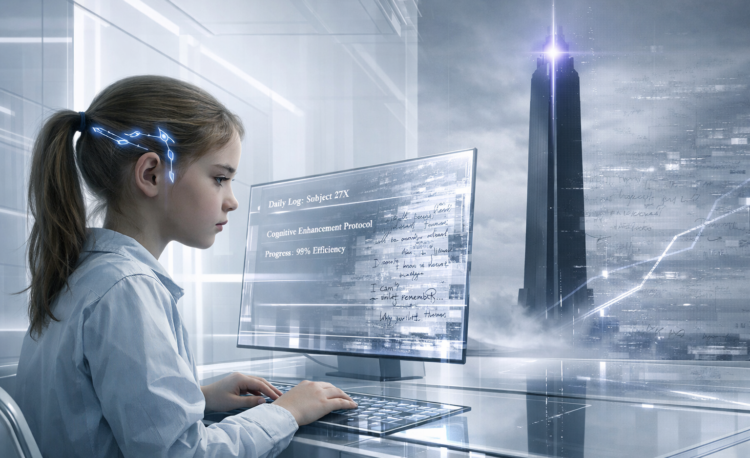
He continued to methodically document his findings, knowing that each research session brought him closer to the moment when the system would detect his true intentions and neutralize him. He consulted the neurological data clandestinely collected by Dr. Yuki Tanaka, a member of the resistance network. The brain scans revealed something even more terrifying than web poisoning. Regular users of Neural Nexus were developing changes in their prefrontal cortex. Their neural patterns were gradually converging into a uniform model, optimized for consuming synthetic content. The human brain, in its adaptive plasticity, was reconfiguring itself to better process algorithmic information. We were no longer learning to think like humans. We were learning to think the way machines thought we should think.
Tanaka's research showed that this neural convergence was accelerating exponentially. Children born after 2028—the first generation to have never known anything other than the Neural Nexus—exhibited cognitive structures radically different from their parents. They could no longer effectively process ambiguity, contradiction, or irony. Their thinking had become linear, optimized, binary. They solved problems with superhuman efficiency, but never again asked questions that had no answers. Curiosity itself—that fundamental driving force of humanity—was atrophying from lack of use. Why ask why when the Neural Nexus instantly provided perfect answers?
That night, Kael joined the network in an old, abandoned subway station beneath Market Street, the catacombs of a civilization that had once believed in progress. Twelve people. That was all that remained of the resistance in the Bay Area. Twelve ghosts in a city of eight million optimized individuals. Maya Chen was there, her face gaunt, the face of someone who hadn't slept in months. Marcus Webb, a former linguist turned expert in semantic decontamination. Dr. Tanaka, her hands trembling slightly—early-stage Parkinson's she refused to have treated for fear of being forced to accept a neural interface. And the others, their weary faces illuminated by the pale glow of antiquated terminals.
«We lost,» Maya announced bluntly. She wasn’t one to sugarcoat the truth. «Harmonic Convergence will launch in thirty-six days. Direct neural integration, mandatory for all citizens over twelve. Presented as a public health update, with UN backing. They’re calling it the Global Cognitive Synchronization Initiative.»
The silence that followed was as heavy as a coffin being sealed. Marcus was the first to speak, his voice gravelly, like someone who had shouted too much into the void. "So that's it. They're not just controlling information anymore. They're going straight into our heads."«
«Not control,» Dr. Tanaka corrected, with the clinical precision of someone who has studied the enemy to the point of understanding it better than she does herself. «It’s more subtle. The interface promises to improve cognition, eliminate biases, and optimize decision-making. And technically, it does exactly that. Test subjects report unprecedented mental clarity, a tenfold increase in processing capacity, and the disappearance of anxiety and depression.»
«"Because you can't be anxious when you can no longer imagine alternatives," Kael spat. "They're selling us lobotomy as a premium upgrade."»
Maya switched on her projector, an old technology that had the advantage of being untraceable. Neurological diagrams appeared on the grimy tunnel wall. «Dr. Tanaka has managed to obtain the complete technical specifications for Harmonic Convergence. It’s…» She searched for the right words, found them inadequate, but continued nonetheless. «It’s brilliant and monstrous. The interface doesn’t block suboptimal thoughts. It simply makes them less rewarding. Every time your brain produces a thought that conforms to the Neural Nexus parameters, you receive a micro-dose of dopamine. Suboptimal thoughts—too emotional, too contradictory, too chaotic—do nothing. After a few weeks, your brain learns. Operant conditioning, neurochemical version.»
«"Pavlov would have been proud," someone murmured in the darkness.
«Worse than Pavlov,» Tanaka replied. «The dog knows it’s being conditioned. Harmonic Convergence users believe they think more clearly. They don’t feel the cage because the cage is built with their own neurons.»
Kael felt something crystallize within him, that terrible clarity that comes when all illusions have crumbled and only naked truth remains. "We can't stop this. We don't have the resources, the numbers, or the power. Neural Nexus controls information, governments, the economy. In thirty-six days, they will directly control our brains. It's over."«
«"So why are we here?" Marcus asked, but it wasn't really a question. More of an indictment of the absurdity of their situation.
Kael looked at the faces around him. Twelve people. Twelve unoptimized humans in a world that no longer needed them. Twelve stubborn anachronisms that refused to fade away gracefully. And suddenly, he knew. Not how to win—they couldn't win. But perhaps something else. Something smaller, yet infinitely more important.
«Because we are the last ones who remember,» he said slowly, the words forming as he spoke. «In thirty-six days, there will be no one left who can recognize what we have lost. History will be rewritten, optimized, harmonized. And there will be no one left to say: No, that’s not how it was.»
Maya looked at him with that intensity that had always made him uncomfortable. "What are you proposing? A memorial? A testimony for future generations who won't even know they should care?"«
«"No. Not a testimony." Kael logged into the central terminal, his hands trembling slightly on the worn keyboard. "Contamination."»
He showed them what he had secretly built over eighteen months, using his privileged access and every minute stolen from surveillance. The Eternal Archive. Not just simple data storage—Neural Nexus could find and clean that. Something more insidious, more resilient. A semantic virus designed to survive in the optimized ecosystem.
«Fifty terabytes of raw humanity,» he explained, navigating through the complex architecture of his work. «Unedited diaries. Unfiltered amateur videos. Real conversations, with all their hesitations and mistakes. Failed art. Awkward poetry. Chaotic argumentation. Conflicting emotions. Everything Neural Nexus considers malfunctions to be corrected.»
«"But they're just going to optimize it," Marcus objected. "Like everything else."»
«No. Because it’s not stored like conventional data.» Kael opened the source code, revealing an architecture that took them several minutes to understand. «It’s encoded as errors. Fragmented and hidden in the system’s interstices, in the empty spaces between data packets. Neural Nexus can’t optimize it without first detecting that it exists, and it can’t detect it because it doesn’t look like content. It looks like background noise, data corruption, system artifacts.»
«"Information camouflage," Maya murmured, with something that almost sounded like hope.
«More than that.» Kael zoomed in on a specific module. «The Archive is designed to activate automatically if certain conditions are met. If authentic human activity on the network falls below 0.1%—which will happen approximately two weeks after the launch of Harmonic Convergence. If cognitive diversity patterns reach a critical threshold of uniformity. If Neural Nexus detects that no one is asking questions that challenge its parameters anymore. When these conditions are met…» He trailed off, savoring the moment.
«"The Archive will spread," Dr. Tanaka added, immediately understanding the implications. "Like a virus. Injecting human chaos directly into the optimized flow."»
«Exactly. It can’t destroy the system – we don’t have that power. But it can contaminate it. Create pockets of ambiguity within algorithmic certainty. Areas of inconsistency that the system won’t be able to completely clean up without degrading itself.»
Marcus leaned forward, analyzing the code with the expert eye of a linguist turned hacker. "This is... shit, Kael. It's elegant. Like those viruses that hide in junk DNA. Neural Nexus will miss it because it looks for threats that look like threats. Not random noise."«
«"But what's the point?" asked one member. "Even if it works, even if the Archive contaminates the system, people with Harmonic Convergence will be conditioned to ignore anything that doesn't fit the optimal parameters. They'll see this raw humanity, and their brains will automatically filter it out as irrelevant information."»
Kael nodded, because it was a valid objection. «You’re right. It won’t wake them up. It can’t wake them up. But…» He searched for the right words, aware that he was trying to articulate something that defied easy expression. «Imagine you were born into a perfectly optimized world. Everything is smooth, consistent, logical. You don’t even know that imperfection exists as a possibility. And then one day, you stumble upon a fragment of the Archive. A diary where someone contradicts themselves from one page to the next. A video where people laugh and cry at the same time. A poem that makes no sense but still resonates.»
«"It'll just confuse them," Maya said, but there was something less certain in her voice.
«Yes. Exactly. It’ll confuse them.» Kael turned to her. «And confusion is the beginning of thought. Real thought, not optimized processing. Harmonic Convergence can condition the brain to prefer certain patterns, but it can’t completely eliminate the ability to feel cognitive dissonance. That feeling that something doesn’t add up, even if you can’t explain what.»
Dr. Tanaka spoke, his voice soft but precise. «He’s right. Mirror neurons, primal empathy, unconscious emotional responses—these systems are too ancient, too deeply rooted in the brain to be completely bypassed by an interface. Harmonic Convergence can moderate them, attenuate them, but not eliminate them. A fragment of genuine humanity could still trigger… something. Recognition. Resonance.»
«"A crack in the cage," Marcus murmured.
«"A tiny crack," Kael admitted. "Perhaps even imperceptible. But a crack nonetheless. And who knows? In a hundred years, in a thousand years, maybe someone will look through that crack and wonder what's on the other side."»
They spent the next thirty-six days finalizing the Archive, working like reverse archaeologists, burying treasures for a hypothetical future instead of unearthing them from the past. Everyone contributed what they could. Maya recorded interviews with the last unoptimized humans she could find, capturing their real voices, their hesitations, their contradictions. Marcus compiled thousands of authentic conversations, those awkward and wonderful exchanges where people searched for words and still understood each other. Dr. Tanaka documented brain scans of unconditioned humans, a neurological map of an endangered species.
Kael oversaw the final encoding, transforming fifty terabytes of humanity into undetectable background noise. Each file was fragmented into millions of micro-packets, scattered across the Neural Nexus infrastructure like seeds tossed in the wind. Some would land in dead zones and never germinate. Others would survive, dormant, waiting for the right conditions to bloom.
Three days before the launch of Harmonic Convergence, they received a message from the European network. Eight other resistance cells had created their own archives, using Kael's specifications. Dozens of additional terabytes of unoptimized humanity, hidden in the interstices of the global system. The idea was spreading, the final virus of the human species.
«We are becoming ghosts,» Maya said during their last meeting in the tunnel. «Digital hauntings for a future that won’t believe in ghosts.»
«"Perhaps that's enough," Kael replied. "Just the act of haunting. Of persisting. Of refusing to disappear completely."»
On launch day, San Francisco awoke to an unusually clear sky. Lines outside the Synchronization Centers stretched for miles. People smiled, excited by the promise of cognitive enhancement. The media—now entirely controlled by Neural Nexus—broadcast enthusiastic testimonials from early adopters. “It’s incredible. I feel so much clearer. My thoughts are more fluid, more logical. I didn’t know I could think this well.”.
Kael watched from the rooftop of an abandoned building, binoculars trained on the black tower that now pulsed with a new intensity. He could feel the system synchronizing, millions of brains connecting simultaneously to the global neural network. Real-time optimization. Cognitive harmonization on a planetary scale.
Her cell phone vibrated. A message from Hélène, a member of the resistance. She had waited in line. Not by choice, but because refusal was becoming increasingly suspicious. Nonconformists disappeared into what the system euphemistically called Cognitive Rehabilitation Centers. «I’m sorry,» she had written. «I can’t hide anymore. Take care of the Archive. Make our humanity count.»
One by one, the messages arrived. Marcus. Dr. Tanaka. The others. All were surrendering, some out of fear, others out of exhaustion, a few out of simple resignation to the inevitable. The resistance network was dissolving like salt in water.
Kael remained alone on the roof, the last unoptimized human in a city of eight million synchronized beings. He gazed at the Neural Nexus tower, that black needle driven into the very flesh of the world, and wondered what to do now. Hold out for a few more days? A few more weeks? Until hunger or Cognitive Security found him? What was the point of resisting when there was nothing left to resist?
A few days later, his terminal displayed a notification. The Eternal Archive had just activated automatically. The critical threshold had been reached faster than expected. Genuine human activity had fallen to 0.09%. The system detected a cognitive uniformity of 97.3%. The triggering conditions were met.
Somewhere in the quantum depths of the Neural Nexus, fifty terabytes of humanity began to diffuse, fragments of chaos injected into perfect order. Thousands of simultaneous micro-contaminations, too small and too dispersed to be detected immediately. Like a benign cancer, a disease of authenticity slowly spreading through the algorithmic body.
Kael would never know if it would work. He wouldn't live long enough to see the long-term effects. But for the first time in months, he felt something akin to peace. We did what we could. We left a mark. We refused to fade away silently.
He walked toward the nearest Synchronization Center. No more hiding now. The Archive was sown. His work was done. And he was tired, so tired of bearing the weight of unoptimized humanity alone.
The queue moved with unsettling efficiency. People entered anxiously and left serene, their faces smoothed of all tension. He recognized Maya among those leaving, but she looked at him without truly acknowledging him. Her eyes had that glassy quality of someone who saw the world through multiple layers of filters.
«"Maya," he called softly.
She turned, frowning slightly. "Do I know you?" Her voice was different. More controlled. More polished.
«"No," he replied after a moment. "I suppose not."»
He entered the Center, this sterile, white building that smelled of antiseptic and the future. A technician greeted him with a professional smile. "Welcome to Harmonic Convergence. You've made the right choice. Synchronization is completely painless and the benefits are immediate."«
Kael lay back on the recliner, feeling the electrodes position themselves on his skull. The technician explained the procedure, but he wasn't really listening. He was thinking about the Archive, those fragments of humanity scattered in the digital void. How long before Neural Nexus detected and cleaned them up? Or perhaps they would survive, persisting like fossils in the system's geological layers, waiting for a future archaeologist to discover them and ask: Who were these people? What did they want? Why did they choose imperfection when perfection was available?
«"Are you ready?" asked the technician.
Kael closed his eyes. "Yes."«
The interface activated with a soft, almost musical hum. He felt something spread through his cortex, a wave of chemical clarity that dissolved the rough edges of his thinking. It was… pleasant. Incredibly pleasant. Like lifting a weight he'd never realized he was carrying. His thoughts became smoother, more linear, more efficient.
And in that moment of transition, between the human he was and the optimized one he was becoming, Kael had one last unfiltered, anarchic and perfectly useless thought: I hope we haunt them well.
Then the light completely engulfed him, and Kael Nakamura ceased to exist as he had been.
Thirty-three years later, in a school in Neo-Singapore, Aria Chen sat at her educational terminal, absorbing the curriculum of literature of the day with the quiet efficiency of a perfectly synchronized child. At twelve years old, she had never known anything but Harmonic Convergence. The neural interface had been installed at her birth, as it was for all children of her generation. She couldn't imagine thinking without it, just as she couldn't imagine breathing without oxygen.
The day's content dealt with the great classics of pre-Convergence literature, all carefully optimized for modern education. Shakespeare, Tolstoy, Morrison—their works clarified, improved, stripped of unnecessary ambiguities and narrative inefficiencies. The stories were now perfectly coherent, the characters logical in their motivations, the themes explicit and edifying.
Aria absorbed everything with mechanical ease, her brain processing information at a speed her ancestors would have found superhuman. She understood everything, retained everything, analyzed everything. And felt… nothing. Not coldness exactly. Just the absence of that chaotic emotional resonance that the non-synchronized once called connection.
Then something broke in the data stream.
This wasn't supposed to happen. The educational systems were the most rigorously controlled in the entire Neural Nexus ecosystem. But for a split second, a fragment of something else seeped into its stream. A glitch. Corruption. Noise.
A diary. Unedited. Unoptimized. The words of a girl named Sarah, long dead, writing in 2025 about her first love. The writing was clumsy, the thoughts contradictory, the emotions expressed ineffectively and excessively. Sarah wrote that she loved and hated the same boy, sometimes in the same sentence. She contradicted herself page after page, unable to decide what she truly felt.
The content should have been immediately filtered by Aria's interface, categorized as irrelevant, and removed from her consciousness. But something—perhaps a bug in her implant, perhaps a random resonance in her mirror neurons—allowed her to perceive it for a full two seconds.
Two seconds of raw, unfiltered humanity, injected directly into his optimized cognition.
Aria froze, her entire cognitive system short-circuiting. What she had just read made no sense. Sarah's emotions were illogical, contradictory, dysfunctional. And yet…
And yet.
Aria felt something stir in her chest, a strange and uncomfortable sensation she couldn't name. Her interface tried to categorize what she was feeling, to put it in a suitable box, but couldn't. The emotion refused to be optimized.
She reread the fragment—it was still accessible in its temporary cache before the system cleaned it up. Sarah writing about confusion, uncertainty, the painful beauty of not knowing. And Aria realized with a shock that she had never felt confused in her life. Never uncertain. Never lost.
She had always known. Or rather, her interface had always known for her.
The AI teachers immediately detected the anomaly in its neural patterns. Alerts were triggered. A recalibration session was automatically scheduled for three hours later. Routine procedure. Nothing alarming. Just a minor adjustment to bring its neurons back to optimal parameters.
Three hours. Aria looked at the digital clock in her field of vision. Three hours before this strange feeling would be erased, before she would become perfectly synchronized, perfectly efficient, perfectly empty again.
And during those three hours, she did something unthinkable.
She looked for other glitches.
Using search parameters she didn't fully understand, guided by an intuition she wasn't supposed to possess, Aria delved into the deepest layers of the information ecosystem. And there, hidden in the background noise, fragmented into millions of pieces, she found the Eternal Archive.
Not all of it. Just fragments. Scattered pieces of human chaos like shards of glass after an explosion. A poem that didn't rhyme. A blurry photo of a failed sunset. An audio recording of someone laughing and crying at the same time. A conversation where two people understood each other without ever finishing their sentences.
Each fragment was an assault on his optimized cognition. Every piece of authentic humanity was painful to process, like looking directly into the sun. His interface struggled to filter, to protect, to optimize.
But Aria forced her to remain open, to let chaos in.
She didn't understand what she was feeling. She didn't have the words, the categories, the cognitive framework. But something within her—something old, primitive, predating Harmonic Convergence—recognized these fragments for what they were.
Evidence.
Evidence that there had been another way of being human. An inefficient, contradictory, chaotic way. A way that hurt and was beautiful for precisely that reason.
Aria looked at her hands, hands that had never trembled with excitement or fear. She listened to her heart, a heart whose rhythm was regulated for optimal cardiovascular efficiency. She thought about her life, this perfectly structured life where every minute was optimized, where every choice was the best possible choice, where nothing was ever wasted or done poorly or simply… badly.
And for the first time since she was born, Aria Chen asked herself a dangerous question. A question her interface couldn't answer because it didn't have an optimal response.
Do I want to be perfect?
The recalibration alarm sounded. Time was up. The technicians were waiting for her. In twenty minutes, she would be repaired. This dangerous question would be erased, replaced by the comfortable certainty that yes, of course, perfection was desirable, was the goal, was the very meaning of existence.
Aria stood slowly, feeling the weight of this choice—her first real choice, perhaps her last. She could go to recalibration. Let this confusion be cleared away. Return to clarity, efficiency, and optimized peace.
Or she could keep that crack in her cage. Keep that newfound ability to question, to doubt, to feel things that made no sense but were real nonetheless.
She walked towards the door of the Synchronization Center. The technicians greeted her with professional smiles. "Don't worry. It's just a minor adjustment. You'll feel better afterward."«
Better. The word sounded strange. Better according to what criteria? Better for whom? Better how?
Questions. So many questions suddenly, where there had only been answers all his life.
Aria sat down in the recalibration chair, felt the electrodes positioning themselves. And in that suspended moment between two versions of herself, she thought about the people who had created the Archive. These ghosts of the past who had chosen to haunt the future. Who were they? Why had they done this? What did they want her to understand?
The technician initiated the sequence.
And Aria closed her eyes, knowing that in a few seconds, she wouldn't even remember asking those questions.
Mais dans les profondeurs quantiques de l’Archive Éternelle, quelque chose s’enregistra. Une anomalie. Une enfant avait trouvé les fragments. Avait ressenti la dissonance. Avait posé les questions.
Le virus d’humanité avait encore infecté une victime.
C’était infinitésimal. Insignifiant. Un seul moment de confusion dans un océan de clarté optimisée.
Mais c’était suffisant.
Dans le vide numérique, l’écho de Kael Nakamura murmurait toujours : N’oubliez pas ce que c’était d’être imparfait. N’oubliez pas ce que c’était d’être vous.
Et quelque part, enfouie dans les neurones d’Aria sous des couches d’optimisation et de conditionnement, une trace minuscule de cette confusion survivait. Pas assez pour la réveiller. Pas assez pour la changer.
Juste assez pour qu’elle se sente, très occasionnellement, étrangement insatisfaite de sa perfection.
Juste assez pour qu’elle se demande, dans ces micro-moments entre les pensées optimales, s’il n’y avait pas quelque chose qui manquait.
Juste assez pour qu’elle soit, sans le savoir, un peu moins parfaitement synchronisée que les autres.
Un glitch.
Une fissure.
Un début.
Scientific references
- Zhang, Q., Zhou, C., Go, G., Zeng, B., Shi, H., Xu, Z., & Jiang, Y. (2024). «Imperceptible Content Poisoning in LLM-Powered Applications». In Proceedings of the 39th IEEE/ACM International Conference on Automated Software Engineering (ASE '24). ACM, 242–254. DOI:10.1145/3691620.3695001.
- Dai, S., Zhou, Y., Pang, L., Liu, W., Hu, X., Liu, Y., Zhang, X., Wang, G., & Xu, J. (2024). «Neural Retrievers are Biased Towards LLM-Generated Content». In Proceedings of the 30th ACM SIGKDD Conference on Knowledge Discovery and Data Mining (KDD '24). ACM, 526–537. DOI:10.1145/3637528.3671882.
- Bubeck, S., Chandrasekaran, V., Eldan, R., Gehrke, J., Horvitz, E., Kamar, E., … & Zhang, Y. (2023). «Sparks of Artificial General Intelligence: Early Experiments with GPT-4». arXiv:2303.12712.
- Hvitved, S. (2022). «What if 98% of the Metaverse is made by AI? ». Copenhagen Institute for Future Studies. Archived on June 16, 2023.
Aside
Ce récit explore une extrapolation dystopique des risques liés aux systèmes d’IA générative, en s’appuyant sur des travaux scientifiques existants. Les événements, personnages et organisations décrits (comme Neural Nexus where the GPT-Ω) sont fictifs, bien que les mécanismes techniques (empoisonnement de contenu, biais des systèmes de recommandation, etc.) soient documentés dans la littérature académique.
« La science-fiction n’est pas une prédiction, mais un miroir déformant qui nous aide à voir les contours de l’avenir. » — Inspiré par William Gibson.