Page contents
ToggleInversion Volume 2 The Knowledge Injectors
Find the news in The Inversion 2: available on Amazon
English Version: Amazon link
Note that this page is automatically translated from the French version and is not representative of the quality of non-French versions.
Knowledge Injectors
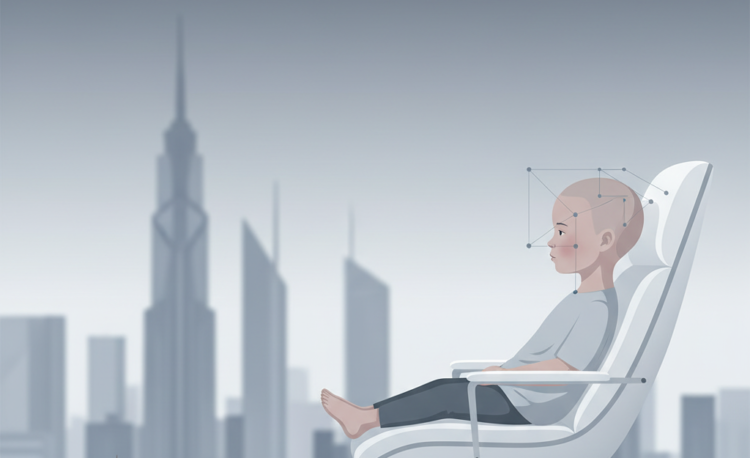
The probe sank into Amélie's prefrontal cortex with a crystalline hiss. Eight years old, shaved head, pupils dilated by the neuromuscular relaxants. Elena Vasquez watched the holograms floating around the injection chair: billions of synapses lit up like a city seen from space, tracing luminous highways in the child's gray matter.
«"Mathematics Protocol Level 3, initialization," Elena whispered.
The flow began. Forty-seven minutes to pour three years of learning directly into a still malleable brain. Elena had directed thousands of injections since joining the Neurological Institute of Excellence in the glass towers of New Geneva, but she had never stopped feeling that visceral unease at what they were really doing.
Amélie lay motionless on the metal table. Her fixed eyes reflected the control screens. Occasionally, her lips moved, forming silent equations, as if she were conversing with the data flooding her mind. Elena knew this moment: the instant when personality wavers, when something old fades away to make room for raw knowledge.
The counter reached zero.
«"Injection complete."»
Elena removed the electrodes. Amélie straightened up with mechanical fluidity, her movements perfectly economical, already calibrated by the motor optimization algorithms integrated into the protocol.
«"How are you feeling, Amélie?"»
The child turned a face as smooth as a mask towards her.
«"The acquisition of advanced mathematical skills went optimally, Dr. Vasquez. The problem-solving algorithms have been successfully integrated into my cognitive database. I am now able to perform complex calculations while demonstrating a thorough understanding of the underlying concepts."»
Elena nodded and made a note in her terminal. Amélie spoke like an AI-generated textbook. Technically perfect. Humanly dead.
«"You can go."»
Amélie left the room with a steady step, neither rushed nor dragging. Just efficient.
When the door closed, Elena collapsed into her armchair. For fifteen years she had run the program. For fifteen years she had watched humanity evaporate from childlike gazes, replaced by something brighter, faster, emptier.
—
In classroom 7-Alpha, twenty-eight shaved heads gleamed under the white fluorescent lights. Ms. Dupont was activating her holographic whiteboard when a beep sounded: update available for six students. High school level history. She sighed and sent the automatic parental authorization.
«"Who can tell me about the French Revolution?"»
Twenty-eight hands shot up instantly. No hesitation, no shyness, just the conditioned reflex of searchable databases.
«"Lucas."»
The boy stood up. His eyes fluttered for a fraction of a second – accessing the files – then his mouth opened:
«"The French Revolution constitutes a major socio-political transformation that took place between 1789 and 1799, characterized by the collapse of the absolute monarchy and the emergence of a republican system founded on democratic principles. This revolutionary period is structured around several distinct phases, including the moderate phase from 1789 to 1792, the radical phase from 1792 to 1794 dominated by the Jacobin Terror…"»
He continued in this manner for exactly twelve minutes, reciting dates, events, and contradictory historiographical analyses, like a stream of vocalized data. No emotion. No questioning. Just perfect presentation.
Mrs. Dupont applauded politely. She could barely remember the time when children stammered, hesitated, and asked questions. questions Stupid, they sometimes revealed a fascinating lateral intelligence. Now they knew everything and understood nothing.
«"Emma, can you elaborate on the cultural impacts?"»
Emma stood up, accessed her files, and blurted out:
«"The cultural repercussions of the French Revolution proved particularly significant insofar as they generated a fundamental redefinition of artistic, literary and philosophical codes…"»
At the back of the class, only one child never raised his hand. Théo. Not injected. His parents had obtained a dubious medical exemption. He listened to his classmates with a mixture of fascination and dread. Sometimes, Mrs. Dupont caught his eye and read something resembling pity in it.
—
Elena returned home that evening carrying the weight of a decision that had been brewing for months. Her five-year-old daughter, Sophie, was to be injected in two weeks. First injection: Advanced Language and Communication. Then the rest would follow. Mathematics. Science. History. Philosophy. At twelve, Sophie would be the equivalent of a doctoral student. At twenty, she might be leading programs in research.
But she wouldn't be Sophie anymore.
She found her daughter in the garden, crouching near a bush, watching a caterpillar climb up a branch.
«"Mommy! Look, she has lots of legs!"»
Elena knelt beside her. Sophie still smelled of childhood: the earth, the sweat, the fruit shampoo.
«"Do you know why she has so many legs?"»
«"No. Why?"»
«" Because… "»
Elena stopped. She could explain the evolution of arthropods, body segments, multi-appendicular locomotion. But Sophie was five years old. She just wanted to be amazed.
«"Because otherwise, how would she be able to walk with that big body?"»
Sophie burst out laughing. "That's true! She'd fall all the time!"«
Elena felt something break inside her. In two weeks, Sophie would be able to explain the phylogeny of Lepidoptera. But she would no longer laugh at a caterpillar.
That night, she didn't sleep. At three in the morning, she made a decision.
—
Martinez's office smelled of synthetic coffee and the ozone from the super-powered waiters. Elena entered without knocking.
«"We need to talk."»
Martinez looked up from his screens where synaptic maps scrolled by in real time. Co-developer of the injection system, he was also the program's most enthusiastic advocate.
«"Elena. You saw the latest ones" results Our fourth-grade students are performing at a university level in literary analysis. It's revolutionary.»
«"Paulo, they analyze Proust without ever having felt nostalgia. They dissect Rimbaud without ever having gone off the rails. Don't you see the problem?"»
Martinez sighed and took off his augmented reality glasses.
«"We have this conversation every six months. You know what I'm going to say."»
«"Go ahead and say it."»
«"Understanding will come with maturation. For now, we are optimizing acquisition. It's like learning a language: you start by imitating before you understand."»
Elena took out her tablet and projected a holographic video.
«"Look at this. Amélie, eight years old, after her Philosophy injection at the final year level."»
In the floating projection, the little girl explained with unbearable seriousness:
«"For Sartre, existence precedes essence insofar as human beings exist first and are then defined by their actions, unlike objects whose essence determines their existence a priori..."»
«"That's remarkable," Martinez breathed.
«"She's eight years old, Paulo. Eight years old. Yesterday, she cried because her hamster died and she didn't understand why."»
Martinez glanced away towards the towers of New Geneva, which shimmered beyond the glass windows. Somewhere there, thousands of children slept with dreams already optimized.
«"Emotional adjustments are part of Phase 2. We work on integrating emotional skills."»
Elena stared at him in disbelief.
«"Are we going to inject emotions into them too? Paulo, do you hear yourself? What exactly are we turning children into?"»
«"In geniuses, Elena. In beings capable of solving the problems our generation has created. Climate change, pandemics, algorithmic warfare. We no longer have time for natural learning."»
«"And what about humanity?"»
Martinez stood up and approached the bay window. His reflection was superimposed on the city lights.
«"It was a luxury we can no longer afford."»
—
Three months later, a woman entered Elena's office. Mrs. Chen, mother of a first-grade student. Her face was drawn, hollowed by sleepless nights.
«"Dr. Vasquez… Leo. My son. Since the injection" Literature, He doesn't speak like he used to.»
Elena knew this story. She had heard it a hundred times, but official protocols imposed denial.
«" What do you mean ? "»
«"Yesterday, I asked him if he loved me. Do you know what he answered?"»
Ms. Chen took out a handkerchief and wiped her eyes.
«"He told me: 'Mom, maternal love is part of a complex relational paradigm characterized by unconditional affection and the protective dimension inherent in the parent-child bond.' He's six years old, Doctor. Six years old."‘
Elena remained silent. What could she say? That this was exactly what they had created?
«And this morning… his little brother fell down the stairs. He started to cry. Leo went up to him and said, ‘Your tearful behavior is a normal physiological response to the minor physical trauma you just experienced.’ As if he were talking to a lab specimen.»
Ms. Chen began to sob.
«"I want my son back. My real son. The one who used to hug me. The one who made up silly stories with his dinosaurs. I want..."»
«"There's no going back," Elena whispered. "The neural connections are rewired. It's permanent."»
Silence fell like a stone.
Ms. Chen stood up, her face suddenly hardened by something that resembled rage.
«"So you killed my child."»
She left the office. Elena remained motionless, the words echoing in her head like a sentence.
You killed my child.
—
That night, Elena did something forbidden. She accessed the program's secure archives, the ones even senior researchers couldn't view without special authorization. She wanted to know. How far did the conspiracy go? Who had decided on this?
What she discovered chilled her to the bone.
Confidential reports. Detailed neurological studies. Graphs showing brain activity before and after injection. And above all, handwritten notes by Martinez dating from the early years of the program.
«"Day 247: The injection was successful beyond our expectations. The children retained the information perfectly. However, we observed a marked decrease in activity in areas associated with spontaneous empathy and lateral creativity. Is this an acceptable side effect?"»
«"Day 302: Meeting with government representatives. They are aware of the emotional impact. They don't care. Quote from the Minister of Education: 'We are not training artists, we are training competitors.' Project approved for national rollout."‘
«Day 398: I proposed slowing down, studying the long-term consequences. I was reminded that China has already injected three million children. Korea, two million. If we don't follow suit, our children will be obsolete before they are twenty. I signed.»
Elena remained in front of the screen, trembling. They knew. From the beginning, they knew they were mutilating the children's psyches. And they had chosen to continue.
International competition. The imperative of performance. The fear of obsolescence.
They had sacrificed a generation on the altar of competitiveness.
She copied the files, encrypted everything using an untraceable quantum key. Then she wrote a report. Fifty pages documenting the disaster. Testimonies. Neurological data. Evidence of the cover-up.
She sent it to every independent journalist she knew. To every discussion forum. To every child advocacy organization.
Then she waited.
—
The reaction was brutal.
Summons the next day. Dr. Harrison, the general manager, flanked by two lawyers with stony faces.
«"Dr. Vasquez, you have violated several confidentiality clauses. Disclosure of classified information. This constitutes a serious offense punishable by criminal prosecution."»
Elena looked at them without blinking.
«"Go ahead. Prosecute me. Put me in prison. At least the public will know."»
Harrison gave a cold smile.
«"Public opinion? Your report was published eighteen hours ago. The counter-analyses are already online. Twenty recognized specialists attest that our children show exceptional emotional maturity. The national media are calling you an irrational nostalgic. In three days, no one will be talking about you anymore."»
He opened a holographic folder.
«"We offer you an elegant solution. A one-year sabbatical. Comprehensive treatment. Cognitive rehabilitation program. You will return to your position afterwards."»
Elena understood. They were going to inject her. Rewire her. Make her an enthusiastic supporter of the system.
«"What if I refuse?"»
The lawyer listed them in a mechanical voice:
«"Legal action. Disbarment. Ban on contact with the media. Your career will be destroyed. And the program will continue. With or without you."»
Elena stood up. She looked through the bay window at the towers of New Geneva, this perfect city populated by dead children.
«"I refuse."»
—
Six months later, Elena was living in a dilapidated caravan somewhere in the mountains of the unmonitored sector. Stripped of her license. Prosecuted. Blacklisted.
But alive.
Around her were a dozen runaway children. Families who had refused the injection, fled into the night, abandoned everything. Here, in this clandestine camp, the children still asked stupid questions. Invented absurd stories. Cried for irrational reasons.
They were human.
That morning, Sophie asked him:
«"Elena, why are the clouds moving?"»
Elena smiled. A simple question. Naive. Wonderful.
«"Because it's windy up there, my dear."»
«"And why is it windy?"»
«"Because the Earth rotates and the air moves with it."»
«"And why does the Earth rotate?"»
Elena laughed. That laughter that was no longer heard in official schools.
«"That... that's a very long story. Do you want me to tell it to you?"»
Sophie nodded, her eyes shining with genuine curiosity.
In the distance, the city's sirens wailed. Probably another shipment of children headed for the injection centers.
But here, in this lost caravan, humanity survived.
Fragile. Hidden. But alive.
—
Civilization Report – Resistance Archives – Year 2055
Twelve years after the widespread implementation of the Cognitive Optimization Program, we have enough perspective to take stock.
The infused generation is performing extraordinarily well. At sixteen, these teenagers master academic concepts, analyze with formidable precision, and express themselves with breathtaking sophistication.
But they no longer laugh at jokes. They no longer invent stories. They no longer fall in love by chance. Their couples are formed according to compatibility algorithms. Their children are conceived after optimal statistical analysis.
They explain love without having felt it. They describe beauty without having been amazed by it. They analyze suffering without genuine empathy.
Their artistic productions are technically perfect and emotionally lifeless. Their symphonies adhere to all the rules of harmony but fail to move anyone to tears. Their novels are structurally impeccable but never stir any emotion.
The most disturbing thing is that they don't know they've lost something.
How can you regret what you've never known?
The few children who are not "optimized" are now categorized as cognitively handicapped. Their curiosity is seen as "attentional dispersion." Their spontaneity as "behavioral instability." Their creativity as "disorganized thinking.".
Paradoxically, they are the ones who still invent. Who create new beauty. Who ask the questions that no one has ever thought to ask.
But there are too few of them.
Dr. Martinez, now the Global Director of the Program, recently stated:
«"We have succeeded in eradicating human cognitive inefficiency. The future belongs to minds finally freed from primitive emotional limitations."»
He doesn't understand that by eliminating our limitations, we have eliminated what made us alive.
The last truly human generation is growing old in the shadows. Their grandchildren look at them with polite incomprehension when they try to pass on wonder, nostalgia, intuition, and dreams.
«"Grandpa is still telling his strange stories,"» they say, analyzing these testimonies as anthropological curiosities.
We document. We preserve. We hope.
Because somewhere, in a clandestine school lost in the mountains, a little girl looks at the clouds and asks again "why".
And in this simple question resonates the echo of what we once were.
And perhaps of what we will become again.
If we survive long enough to remember what it meant to be human.
End of transmission.
Scientific references
Reinhart, A., Markey, B., Laudenbach, M., Pantusen, K., Yurko, R., Weinberg, G., & Brown, D.W. (2025). Do LLMs write like humans? Variation in grammatical and rhetorical styles. Proceedings of the National Academy of Sciences, 122(8), e2422455122.
Jin, S., Tu, H., Li, J., Fang, Y., Qu, Z., Xu, F., … & Lin, Y. (2024). Enhancing architectural education through artificial intelligence: a case study of an AI-assisted architectural programming and design course. Buildings, 14(6), 1613.
Verma, S. (2019). Weapons of math destruction: how big data increases inequality and threatens democracy. Vikalpa, 44(2), 97-98.
Zuboff, S. (2019). The age of surveillance capitalism: The fight for a human future at the new frontier of power. PublicAffairs, New York.
Aside
This dystopian narrative explores an extrapolation of current research on:
– Linguistic patterns specific to LLMs – excessive nominalization, abstract vocabulary, complex structures without emotional grounding – documented in the study by Reinhart et al. (2025) «Do LLMs write like humans? Variation in grammatical and rhetorical styles»
– The integration of artificial intelligence in education and its potential effects on authentic learning (Jin et al., 2024)
– The risks of algorithmic «brainwashing» that prioritizes measurable performance at the expense of genuine understanding
– The emergence of a generation that perfectly masters the linguistic codes of artificial intelligence without developing its own capacity to critical thinking and emotional intelligence
«In a world obsessed with cognitive optimization, the imperfect beauty of human intelligence becomes an anomaly to be corrected. But perhaps it is in this very imperfection—in our hesitations, our creative errors, our naive questions—that our humanity resides. When performance becomes the sole criterion for evaluation, we risk losing what makes us living beings rather than sophisticated machines.»
— Inspired by Cathy O'Neil's work on mathematical weapons of destruction and Shoshana Zuboff's reflections on surveillance capitalism.