Page contents
ToggleInversion Volume 2 The Signal
Short story available in the book The Inversion 2: available on Amazon
English Version: Amazon link
Note that this page is automatically translated from the French version and is not representative of the quality of non-French versions.
The Signal
Brooklyn, New York
March 17, 2061
Kael Morrison was twenty-three years old when he first died.
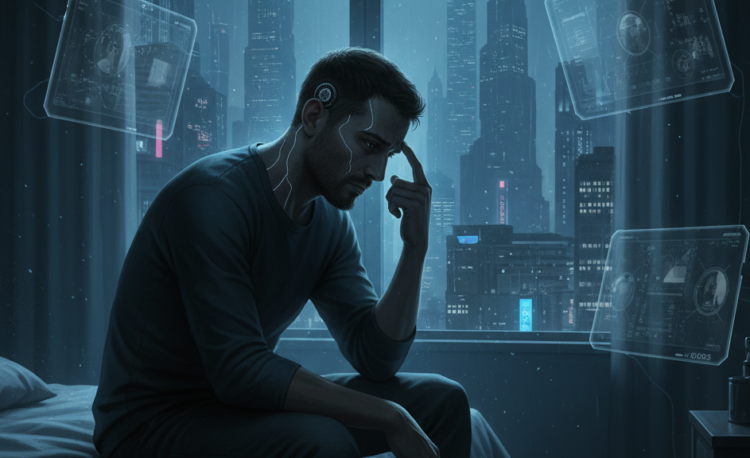
It was a Tuesday. He remembered it because it was garbage collection day, and the automated truck made its characteristic noise down the street below his Bushwick apartment. He was sitting on his battered futon, his finger resting on the neural control button behind his left ear, and he had thought to himself: Just one more time, and then I'll stop..
That was the seventeenth time he had said that to himself today.
He pressed the button.
The universe exploded in pure ecstasy.
Forty-five seconds later, when the impulse subsided and reality hit like a cold shower, Kael realized he'd peed himself. Again. His stomach rumbled—he hadn't eaten since… when? Yesterday? The day before? His phone showed seventeen missed calls from his manager at Brux Logistics. Eighteen now.
He was going to be fired. Probably he already was.
His finger found the button again.
Just one more time.
—
Six weeks earlier
«"It won't hurt," the technician at the NeuroSync clinic in Manhattan promised. "The local anesthetic takes effect in thirty seconds. The implantation takes twenty minutes. You'll be home for dinner."»
Kael had signed the forms without really reading them. After the accident—that delivery drone that had crashed into him at full speed, three fractured vertebrae, six months of opioids that hadn't solved anything—chronic pain had become his only constant. Waking up hurt. Breathing hurt. Exist It hurt.
Deep brain stimulation was supposed to be the miracle cure. Approved by the FDA in 2057, perfected by tech giants, now covered by most insurance plans. Hundreds of implants every month. Satisfaction rate of 941.3%.
What the brochure didn't mention was the remaining 6%.
«The system is fully regulated,» the technician explained as he inserted the neural probe under Kael’s scalp. «The therapeutic AI monitors your neural activity 24/7. It only delivers pulses when your pain sensors exceed the threshold. There’s no risk of misuse.»
Kael had felt a slight buzzing when the device activated. Then… nothing. No pain. For the first time since the accident, his back wasn't screaming.
«You can adjust the intensity with the app,» the technician continued, transferring the interface to Kael’s phone. «But the AI manages it automatically. Don’t touch the advanced settings without medical supervision.»
Of course not. Why would he do that?
—
Five weeks earlier
The first night, Kael slept without medication for the first time since the accident. The second night too. The third, he woke up at 3 a.m. with a cramp in his lower back — nothing serious, just an echo of the old agony.
He opened the NeuroSync app on his phone. The interface was clean, minimalist. An intensity slider. An emergency button for acute attacks. And, hidden in a submenu, a password-protected "Developer Settings" section.
Kael was a software engineer. Or at least, he had been before the accident, before the constant pain turned his code into mush. He knew the systems. He knew the vulnerabilities.
It took him twenty minutes to crack the password by connecting his phone to his computer.
The developer menu opened, revealing a complexity that the user interface had carefully concealed. Stimulation profiles. Neural mapping. Signal frequencies. And, almost innocently, a setting labeled "Override Limbic System".
Kael skimmed the help text: «"For supervised therapeutic use only. Allows direct stimulation of reward centers to treat treatment-resistant depression and PTSD. WARNING: Unsupervised use may lead to addictive behaviors."»
He stared at the screen. His back didn't even hurt that much. It was just curiosity, really. Just to see.
He activated the override. Set the intensity to 3 — low, just to test. And pressed Execute.
The world changed.
It wasn't pleasure. Pleasure was too small a concept, too human. It was as if every neuron in his brain had simultaneously reached orgasm. It was a color he had never seen, a musical note the universe had kept secret until now. It was the answer to a question that he had never been able to ask.
It lasted fifteen seconds.
When it stopped, Kael found himself on his knees on his bedroom floor, panting, in tears, his body trembling from the loss of something he didn't know he wanted until he had it.
It took almost ten minutes before he could move again.
Then he opened the application and pressed it a second time.
—
Now — March 17, 2061
«"Mr. Morrison? Kael? Can you hear me?"»
The voice came from afar, filtering through layers of fog. Kael blinked. Fluorescent lights. An institutional ceiling. The smell of antiseptic and industrial coffee.
«"Hospital," he croaked.
«Brooklyn Methodist,» confirmed a woman in a white coat. Around forty, with short gray hair, she had the weary look of someone who had witnessed too much human degeneration. «I’m Dr. Chen. Neurology. Your neighbors called 911 when they heard a crash. You fell. Severe dehydration, malnutrition, muscle damage from prolonged immobility.»
The memories slowly resurfaced. The futon. The button. Pressing it again and again until his phone died, its battery drained by the app that was siphoning energy from his brain, from the signal. Then press the manual controls on the device itself, again and again, until his vision begins to fragment and the world tilts.
«"How long?" asked Kael.
«You were unconscious for two days. But according to your transaction history—your landlord gave us access after the discovery—you haven’t left your apartment in twelve days. No food deliveries. No activity on your bank accounts. Just…» Dr. Chen tapped his tablet. «Thousands of activations of your NeuroSync implant.»
Kael closed his eyes. "You're going to remove it."«
«" No. "»
Her eyes suddenly opened. "What?"«
«We can’t. Legally, you own the device. Medically, removal requires invasive surgery with significant risks. But most importantly…» Dr. Chen leaned forward. «Your brain has adapted to its presence. Scans show that your natural reward circuits are essentially dormant. Your entire dopaminergic system is rewired around the implant. Sudden removal could cause complete neurological collapse.»
«"So I'm stuck with it."»
«"You're stuck with it. But we can help you. There's a program..."»
«"I don't want a schedule," Kael interrupted. "I just want to go home."»
Dr. Chen sighed. "Mr. Morrison, do you understand what's happening to you? You're a wirehead. Now we see three to four cases a week in this hospital alone. Across the country? Thousands."«
«"I can stop."»
«"No, you can't. Statistically, 97% of untreated wireheads died within six months. You'll die on that futon, finger on the button, smiling while your body decomposes around you."»
Kael looked away. Through the hospital window, he could see Brooklyn sprawling — the old brownstones mixed with the new apartment towers, the delivery drones weaving their routes across the sky, the tiny people on the sidewalks living their tiny lives.
Lives without the signal. Grey, dull, and unbearably slow lives.
«"What difference does it make?" he murmured. "Before the implant, I was in pain all the time. Now, I'm in pain all the time except when I press the button. At least now there are times when I don't suffer."»
«These aren’t moments when you don’t suffer,» Dr. Chen said softly. «They’re moments when you don’t exist. The signal overwhelms everything else. You don’t feel the absence of pain—you don’t feel Nothing except for the signal.»
«" GOOD. "»
«"Do you have any family, Kael?"»
«"A sister. Portland. We don't really talk anymore."»
«" Friends? "»
«"Before the accident, yeah. After..." He shrugged. "It's hard to be social when you're suffering 24/7."»
«"And now? Since the implant?"»
Kael didn't reply. He was thinking about Marcus, his former roommate, who had moved out three weeks ago, saying he couldn't watch Kael "get so wasted" anymore. About Yuki from his old job, who had stopped replying to his messages. About his sister Diane, whose last text simply read: I can't help you if you don't want to be helped..
«The program I was referring to,» Dr. Chen continued, «is called Reconnect. It’s a public-private initiative—funded by the settlement of the class action lawsuit against NeuroSync and other implant manufacturers. It involves a three-month residential, intensive therapy, and a gradual withdrawal protocol.»
«"Success rate?"»
Dr. Chen hesitated. "Four percent achieve complete abstinence over twelve months."«
«"Four percent." Kael laughed bitterly. "Great."»
«But 23% achieve what we call ‘functional coexistence.’ They keep the implant but develop control strategies. They regain jobs. Relationships. Lives.»
«"What's the point of having a life if I can never truly experience it?"»
«"What good is feeling something if you have no life?" replied Dr. Chen.
They sat in silence for a long time. In the corridor, a cart of equipment rattled past. An alarm sounded somewhere, then stopped. The hospital continued its work of keeping people alive, even when they didn't necessarily want to be.
«"What if I refuse?" Kael finally asked.
«"We stabilize you medically and you're discharged. Legally, we can't detain you. You go back to your apartment, you start pressing the button again, and in a few weeks or months, you come back here. If you're lucky. Otherwise, you don't come back at all."»
«"What if I accept?"»
«"We're transferring you tomorrow to the Reconnect facility in Queens. You're entering the protocol. You're suffering—a lot, I won't lie. But you have a chance. A small chance, but a chance."»
Kael looked at his hands. They were trembling slightly—a neurological issue, already beginning. His brain was demanding the signal. Every cell was screaming for the button.
He thought about the futon in his apartment. The smell of piss and neglect. The dream he'd had before the accident — creating his own startup, maybe, or just coding something beautiful, something that mattered.
When had he stopped dreaming?
«"Okay," he said softly. "I'll try."»
Dr. Chen smiled—a small, cautious smile, the smile of someone who had seen too many patients promise and fail. "Good. I'll make the arrangements."«
That night, alone in his hospital room, Kael watched the lights of Brooklyn blink through the fog. His finger kept finding the area behind his ear, searching for the button that had been temporarily deactivated by the medical team.
Just temporarily. It will be reactivated tomorrow for the transfer.
And so, he should choose not to use it.
Again and again and again.
For the rest of his life.
Four percent, he thought. Only four percent.
But four percent was not zero.
It was something.
—
Reconnect Facility, Queens
March 19, 2061
The center looked more like a university dormitory than a rehabilitation clinic. A converted former office building, with large windows and walls painted in warm, supposedly calming colors. Twenty-three patients, all with neural implants, all addicted to the signal.
«It won’t work,» said the guy in the bed next to Kael’s. Thirties, Latino, tattoos on his arms. «You know why? Because they can’t take the button off us. We can walk out of here anytime and press it. They know it. We know it. So why not just… press it?»
«"What's your name?" asked Kael.
«"Javier. You?"»
«"Kael. What's your story?"»
Javier shrugged. "Anxiety implant. PTSD after serving on the front line. The system was supposed to calm my panic attacks. Then I found the hidden settings, like everyone else here. What about you?"«
«"Chronic pain. Accident."»
«Of course. That’s always how it starts.» Javier sat up, swinging his legs off the bed. «You want to know the funny thing? The anxiety’s still there. Worse than before, actually. But when I press the button, I don’t care. When I don’t…» He laughed humorlessly. «It’s hell. So tell me, Kael—why not just live in hell for a few days, then press the button and be in heaven for a few minutes? That’s what I do. It worked for two years.»
«"Do you still have a job?"»
«" No. "»
«" Family? "»
«" No. "»
«" Apartment? "»
Javier did not reply.
«"So it didn't really work, did it?"»
«"Fuck off, man," Javier said, without any real anger. "You'll see. The first day, you think you can do it. The first week too. Then it really starts to bite."»
—
Day 3
The group therapy session was held in what had once been a conference room. Fifteen patients sat in a circle—some trembling, others dissociated, all bearing the same gaze that Kael recognized in his mirror. The gaze of someone who had tasted the divine and now had to return to the human.
«"My name is Sarah and I'm a wirehead," said a woman with pink hair. "It's been eight days since I last used my implant."»
«"Hi Sarah," the group murmured routinely.
«Today, I went outside. First time since my admission. And I saw…» Her voice broke. «I saw a dog. Just a stupid dog in the park with its owner. And before the implant, I would have thought it was cute. But now, I just… felt nothing. Like looking at a flat picture. Everything is flat.»
She wiped her eyes. "And I keep thinking—why? Why suffer through this flatness when I could press the button and feel AllWhat the hell is the point?»
«The point,» said the therapist—Dr. Okonkwo, a calm Nigerian man with tortoiseshell glasses—«is that the button lies. It doesn’t give you a feeling. It gives you a signal. Noise. The difference between seeing this dog and appreciating this dog is that appreciation connects to the rest of your life. It builds memories, associations, meaning. The signal does none of that. It just screams so loudly that you can’t hear anything else.»
«"I prefer shouting to silence," Sarah said softly.
«I know,» replied Dr. Okonkwo. «That’s why it’s so hard.»
When it was Kael's turn, he said, "My name is Kael, and I'm a wirehead. It's been three days. And I agree with Sarah. Everything is flat. But…" He hesitated. "But I remember before the accident. I remember watching a sunrise and thinking it was beautiful. Not transcendent. Not orgasmic. Just… beautiful. And now I can't feel that anymore. And I wonder if I ever will again."«
«You will be able to,» said Dr. Okonkwo. «Not tomorrow. Probably not next month. Your brain needs time to rewire itself, to relearn how natural reward works. But the scans show it’s possible. Slow, but possible.»
«" How long? "»
«"For a partial recovery? Six months to two years. For a complete recovery…" Dr. Okonkwo shook his head. "We don't know yet. This technology has only existed for a few years. You are all pioneers."»
«"Pioneers on their deathbeds," Javier muttered, and several people laughed bitterly.
—
Day 7
Kael woke up at 3 a.m., covered in sweat, his heart pounding. Not a nightmare—worse. A signal dream. In the dream, he had pressed the button and the universe had opened like a flower, revealing colors he didn't know existed, dimensions he hadn't known, the feeling of being both infinitely large and infinitely small.
Then he woke up in that too-firm bed in Queens, and reality was grey and slow and unbearable.
His finger found the button behind his ear. Still there. Still active—the Reconnect protocol didn't deactivate them, didn't delete them. The entire program was built around choice. Learning to choose reality over the signal.
Press or don't press.
Every moment, every breath, the choice.
Do not press, ", Kael said to himself. Just this once. You can press the button tomorrow. Just not now.
It was a lie, of course. He knew that tomorrow he would tell himself the same thing. And the day after. Sobriety was built on strategic lies.
He got up and went out into the common corridor. Someone else was awake — a woman he recognized from therapy, sitting by the window watching the Manhattan skyline glow in the darkness.
«"Unable to sleep?" she asked without turning around.
«"Dreams." Kael sat down next to her. "And you?"»
«"Same here. My name is Priya."»
«"Kael."»
They sat in silence for a moment. A delivery drone buzzed past, its red light flashing against the night sky.
«"I was a developer," Priya said suddenly. "At Google. Good salary, good apartment, good boyfriend. Then I got the implant for endometriosis. You know the rest."»
«"Have you lost everything?"»
«"Everything." She turned to look at him. She was in her mid-thirties, of Indian descent, with sunken, tired eyes. "But you know what's weird? I don't even really care. I remember I should care. I remember being the kind of person who cared about her career and her relationships. But now it's just... the information. Like reading about someone else's life."»
«"Do you think it will come back? The worrying?"»
«"Dr. Okonkwo tells me 'yes.' The scans say maybe. My gut says he doesn't care, I just want to press the button." She laughs softly. "You see the problem?"‘
Kael nodded. The problem was that there was no reason not to press the button except that it wasn't supposed to. But "supposed to" carried no weight against the signal. Nothing did.
«I had a sister,» he said. «Diane. In Portland. Before all this, we were close. After the accident, she was always trying to help me, to support me. She’d call me, send me things, check on me. After the implant…» He paused. «I told her to stop bothering me. Literally those words. She was crying on the phone, and I was just mad that she was stopping me from pressing the button.»
«"Have you spoken to him since?"»
«"No. I don't even know if she knows I'm here."»
Priya thought about it. "You should call him."«
«"And what can I say? Sorry for being human garbage, but I'm better now, except I'm not really better because my brain is fried and I could literally relapse at any moment?"»
«"Yeah," said Priya. "Exactly."»
—
Day 14
The program allowed for supervised outings after two weeks. Kael and three other patients took the subway in Manhattan — their therapist, a young woman named Angela, accompanying them like a parent supervising children.
It was the first time Kael had seen Manhattan since his hospitalization. The city had changed and yet hadn't. No more drones, weaving their intricate patterns between the buildings. No more AR displays, bombarding his contact lenses with ads he'd forgotten to block. No more people wearing masks—not because of illness, just for privacy, anonymity in the crowd. Or perhaps it had all been there before.
They stopped at a café in Chelsea. Kael ordered a latte—something he used to like. It tasted like hot brown water. Not bad. Not good. Just… there.
«"Do you feel anything?" asked Priya, sitting opposite him.
«" No. "»
«"Me neither. It's not good, but not bad, just nothing."»
Sarah—the girl with pink hair—stirred her tea without drinking it. «Dr. Okonkwo says it takes time. That our reward systems are like atrophied muscles. They need to rebuild themselves.»
«"How long can you live without pleasure?" Javier asked. "Seriously. What the hell is the reason to go on?"»
Angela interjected. "The reason is that pleasure isn't meaning. Pleasure is just the signal your brain sends when you're doing something meaningful. But you can have meaning without pleasure. You can choose to do things that matter even if they don't make you feel good."«
«"What's the point? I'm more than fed up with living in hell," said Javier.
«Indeed,» Angela admitted. «It’s absolutely hell. But it’s a hell where you’re alive, where you can build things, where you can have relationships. The signal is heaven where you don’t exist.»
Kael looked out of the café window. A woman with a child was walking by, the kid laughing at something, the mother smiling. A normal scene. Ordinary. Beautiful in its ordinariness, perhaps, if his brain could still process beauty.
He thought about pressing the button.
He did not do it.
Not yet.
—
Day 21
«"Your sister answered."»
Dr. Okonkwo handed Kael a tablet. A text message: Kael, I've been so worried. Yes, I want to talk to you. Call me when you can. I love you.
Kael stared at the screen. Three weeks without a signal, and his brain was starting to form new neural pathways—slowly, like a bud pushing through concrete. He could feel something as he read his sister's message. Not pleasure, not ecstasy, but something. Warm. Fragile.
«"Do you want to call him?" asked Dr. Okonkwo.
«"I don't know what to say."»
«"Start with the truth."»
The video call connected. Diane appeared on the screen — thirty-two years old, short brown hair, her mother's eyes. She had been crying recently.
«"Hey," said Kael.
«"Hey." His voice broke. "You look tired, Kael, are you okay?"»
«"I feel like shit."»
«"Good. You should." Then she laughed through her tears. "Damn, Kael. I thought you were dead. When Dr. Chen contacted me, I thought…"»
«"I'm sorry." The words were inadequate, tiny. "For everything. For pushing you away, for becoming this, for…"»
«"Stop," Diane interrupted. "Just... stop. I don't want excuses now. I just want to know if you're going to succeed. If you're really going to try this time."»
«"I don't know," Kael said honestly. "The statistics are low. My brain is fried. But I try. Every day, I try."»
«"That's all I can ask for."»
They talked for an hour—about little things, unimportant things. Diane's job at a climate tech startup. Her apartment in Portland. The cat she'd adopted. Nothing profound. Nothing healing.
But when the call ended, Kael realized he had spent an entire hour without thinking about the button.
It was something.
—
Day 42
Javier relapsed.
Kael discovered him in their room, prostrate on the floor, his finger on the button, his eyes rolled back, a grotesque smile fixed on his face. He pressed again and again, a pulse every few seconds, his body twitching slightly with each discharge.
«"Shit. SHIT." Kael pressed the emergency button. "I need help here!"»
The medical team came running in. They injected something into Javier—a neural suppressor, Angela explained later. His implant was temporarily deactivated. He screamed when they did it, an animalistic sound of pure loss.
Later, in the common room, Dr. Okonkwo gathers everyone together.
«"Javier is physically fine," he said. "But he chose to leave the program. That's his right. We can't keep him against his will."»
«"Where is he going?" asked Sarah.
«He didn’t say so. Probably back on the streets. That’s where most end up.» Dr. Okonkwo looked around the room, meeting each patient’s eyes. «I’m not going to lie to you. Most of you will end up like Javier. Statistically, almost all of you. But a few—a small, stubborn, lucky percentage—will make it. And I can’t predict who that will be. It could be you. It depends on the choices you make every day, every hour, every minute.»
That night, lying in the bed Javier had left empty, Kael thought about the simplicity of giving up everything. Of going outside, finding a quiet corner, and pressing the button until his body gave out. A happy ending, technically. Death by ecstasy.
It was Larry Niven who coined the term "wirehead" in the 20th century, Dr. Okonkwo said during a lecture. In his stories, being a wirehead was considered worse than death—becoming a slave to your own pleasure, trapped in a loop of eternal bliss that meant nothing.
Niven was right, Kael realized. The signal meant nothing. It was pure noise, disconnected from any context, any history, any humanity.
But God, what a glorious noise.
Her finger brushed against the button.
He thought of Diane. Of Priya and Sarah. Of Dr. Chen and Dr. Okonkwo who believed that four percent was worth fighting for.
He moved his hand away.
Tomorrow, he said to himself. You can press the button tomorrow.
Another lie. Another day.
—
Day 90 — The Program
Of the 23 patients who started the program, seven completed the three months. Two relapsed immediately after leaving the facility. One committed suicide. The other four—Kael, Priya, Sarah, and a quiet guy named Dev—persevered.
«"You are not cured," Dr. Okonkwo said at the farewell ceremony. "You will never be cured. But you have learned to live with the implant without letting it control you. That is more than most people can do."»
Kael returned to Brooklyn, to a new apartment arranged by social services. Smaller than the old one. Cleaner. No memories of urine and neglect.
He found a job—not engineering, not yet. Technical support for a cloud computing company. Miserable pay, but it was something. A place to go, people to interact with, a reason to get out of bed.
Slowly, microscopically, things began to seem less flat. Not good, not yet. But less flat. His coffee had flavor. The music had texture. The sunset from his rooftop was… something. Not transcendent. Not divine. Just something.
He started coding again in the evenings. Small projects, nothing ambitious. An app to track craving triggers. A forum for recovering wireheads. Code that mattered to someone, somewhere.
Diane came to visit him for Thanksgiving. They ate artificial turkey in his small apartment, watched old movies, and talked about this and that. At one point, she took his hand and squeezed it, and he felt something. Warm. Real. Fragile but real.
«"I'm proud of you," she said.
«"Don't be yet," Kael replied anxiously. "I could relapse tomorrow."»
«"You could have. But you didn't today."»
—
One year later — March 17, 2062
Kael stood in Reconnect's group therapy room, but now as a volunteer, not a patient. Fifteen new wireheads stared at him with the same blank stare he had worn a year earlier.
«"My name is Kael and I'm a wirehead," he began. "It's been 365 days since I last used my implant."»
A murmur of respect rippled through the group. One year was mythical. Almost no one reached one year.
«"And I'm not going to lie to you—every day is a struggle. Every morning I wake up and my first thought is the button. Every night I fall asleep thinking about the button. It never goes away. The need never goes away."»
He saw several people collapse, the little hope they had evaporating.
«But,» he continued, «I also discovered something. Life without the signal—real life, not the signal—is not transcendent. It is not ecstatic. It will never make you feel like God. But it has something the signal does not.»
«"What?" someone asked.
«It means something. When I code something and it works, it’s not the brain orgasm of the signal. But it connects to other things—to my identity as an engineer, to my desire to help people, to my recovery story. When my sister tells me she’s proud, it’s not the dopamine rush of the signal. But it has weight. It means something because it’s connected to our relationship, our history, our future.»
He paused, searching for his words. "The signal is infinite. But it is empty. Life is limited. But it is full. Emptiness is transcendent, but that is not living it, and I prefer to live."«
After the session, a young woman — perhaps twenty years old, with an implant for depression — approached him.
«"Do you really think it's worth it?" she asked. "All that suffering, just to feel less than we could feel by pressing the button?"»
Kael thought about his answer. About the past year—the struggles, the near misses, the moments when he'd been absolutely certain he'd support 99%. But also about the small victories. Code deployed to production. Dinners with Diane. A date with a girl from his support group that hadn't terrified him. The slow, deliberate process of meaning rebuilding itself neuron by neuron.
«"I don't know," he said honestly. "Ask me in a year."»
—
Epilogue — 2065
The class-action lawsuit against NeuroSync and other neural implant manufacturers concluded with a $47 billion settlement. New regulations were imposed—mandatory disabling of wireheading potential, enhanced AI monitoring, and uncircumventable locking mechanisms.
Of course, in six months, someone would figure out how to hack them again.
Technology was a genie that couldn't be put back in the bottle. More advanced neural implants were already in development—direct brain-computer connections, memory uploading, cognitive enhancement. Each innovation brought new ways to help people and new ways to destroy them.
The anti-implant movement was gaining ground, particularly among religious people and purists. "Keep humanity human," their signs read. "The natural brain for natural pleasure."«
But for millions suffering from chronic pain, depression, and PTSD, implants remained the only relief that worked. The genie wasn't going back in its bottle.
In the archives of Dr. Amara Chen, now director of the neuroethics department at Columbia, a file bore the name MORRISON, KAEL — SUBJECT 0847.
Recovery time: 389 days.
The Morrison case had become a landmark study. Not because he had succeeded—he hadn't—but because his 389 days had yielded more neurological data on wireheading withdrawal than any other subject. His consent for continuous monitoring, his detailed diaries, his weekly brain scans, his volunteer work—all of this had contributed to understanding the problem.
His support group protocols were now being used in seventeen treatment centers across the country. His code for the early detection of implant abuse behaviors had been integrated into next-generation NeuroSync systems. Six people he had personally mentored were still in recovery, the longest-serving at two years.
Kael Morrison died on April 10, 2062, alone in his Brooklyn apartment, his finger on the button, three days after learning of his sister's death in a delivery drone strike; it was too much to bear. The medical examiner estimated that he had activated the implant at least a hundred times in the final hours of his life, until his heart gave out.
He was twenty-four years old.
His body was found five days later when his colleague Marcus forced the door open. The smile on his face was peaceful, even ecstatic. Like all the wireheads who died while signaling.
Dr. Chen now presented the Morrison case in his lectures, not as a failure, but as a lesson on the nature of neuronal addiction and the fragility of recovery.
«"The Morrison case demonstrated that a year of recovery is not the same as a cure," she explained to her students. "The brain reconnects, but the old pathways never completely disappear. A sufficiently intense trauma can short-circuit months of progress in seconds."»
She paused, looking at the faces of her class — future neurologists, ethicists, implant engineers.
«But his 389 days taught us something crucial: recovery is possible. Not guaranteed. Not permanent. Not easy. But possible. And during those 389 days, Kael Morrison helped others. He contributed to science. He had an impact. His life, however short, meant something beyond the signal.»
She displayed one last slide — an excerpt from Kael's journal, written on day 365:
«"One year today. I don't know if I'll make it through another day, let alone another year. But I do know this: every day without the signal is a day when I am human. I love living, but the signal terrifies me every day; I always have to tell myself No."»
Bibliographical References
Klein, E., Goering, S., Gagne, J., Shea, CV, Franklin, R., Zorowitz, S., … & Widge, AS (2016). Brain-computer interface-based control of closed-loop brain stimulation: attitudes and ethical considerations. Brain-Computer Interfaces, 3(3), 140-148.
Pugh, J., Pycroft, L., Sandberg, A., Aziz, T., & Savulescu, J. (2018). Brainjacking in deep brain stimulation and autonomy. Ethics and information technology, 20(3), 219-232.
Coin, A., Mulder, M., & Dubljević, V. (2020). Ethical aspects of BCI technology: what is the state of the art?. Philosophies, 5(4), 31.
Aside
This narrative draws directly on current research into deep brain stimulation (DBS) and brain-computer interfaces (BCIs), legitimate medical technologies that have the potential to be misused for addictive purposes. Bibliographic works specifically explore the risks of "brainjacking"—the hacking or hijacking of brain implants to produce non-therapeutic mental states—while the concept of "wireheading," popularized by the writer Larry Niven in the 1960s, takes on a disturbing dimension as neurotechnologies become a reality.
«"When technology can short-circuit four million years of evolution in a fraction of a second, humanity is no longer in control of its tools—the tools are redefining what it means to be human."»
— Reflection inspired by Kellmeyer (2018) on responsibility in the use of brain data and consumer neurotechnologies.